IMO Meme Whitepaper
A participation economy sharing creative tools and foundational assets people can use to generate revenue
SavorIP · IMO Meme
November 1, 2026 | Issuance design and business operating policy

Official coin image from the IMO Meme page

Designs used in products | Content that introduces me | 3D files ready to hand over for production
IMO Meme provides tools and foundational assets people can use to generate revenue.
IMO Meme is a participation token that gives people who use this environment together an opportunity to create again. An idea that one person starts for free grows into images and videos, products and production files, knowledge and memories. The company sustains this environment through paid creation, commercialization, content and business services.
The business assets we have accumulated are creative tools, original works, characters, production specifications, cultural content, personal programs, travel and advertising connections, and a participation operating framework. These assets form the foundation of IMO Meme's utility.
This whitepaper manuscript combines the public pages with the issuance plan provided. It distinguishes current service policies from future issuance design and does not announce completed on-chain issuance.
1 The value we create
Some people have ideas but give up because of startup costs and the skills needed to make them. Even with photos and drawings, they may not know how to apply them to products; even when they want to open a shop, promotional images and display concepts can be difficult to prepare. The need to preserve memories, learn and express oneself starts from the same place.
The core of IMO Meme is sharing things people can use to produce income. IMO connects people's needs and interests, while Saebori helps them create. SavorIP turns ideas into their own works, product designs, promotional materials and production files. iMo connects recognized participation to the next opportunity to create.
Foundational assets that support production
A generated image means something different when it stays on a screen and when it is used as a product design, promotional material, website or production file. Users obtain materials to start their own businesses, and we earn income from repeat creation and commercialization support. This structure provides assets customers can use themselves; it does not guarantee their business sales.
Value beyond price
Family memories, a character reflecting personal taste, the satisfaction of completion, new knowledge and self-understanding hold different values for different people. The meme in IMO Meme is a culture in which these experiences and expressions reach others and are created anew. We do not confuse the possibility of new uses arising as participation grows with an endlessly rising token price.
- Participation and iMoAn opportunity to create again
- Use creation toolsImages, video and design
- Assets for my businessProducts, promotion and production files
- Opportunities to use and sellThe ability to create again
How an opportunity to create opened through participation can develop into one's own work and foundational business assets
Creation and production provide foundational business materials; culture and personal programs expand learning, memories and self-expression; spaces and travel broaden the use of works and connections between people. The company earns income from creation, commercialization, content and business services throughout this process.
The whitepaper begins with the business's differentiation, utility and income channels. It explains target scale, repeat creation, costs and break-even points, and connects them to issuance, rewards, technology and an execution plan.
2 Our business differentiation and growth principles
We reuse original works and creative tools already prepared for different customers' purposes. A single original work leads to images, videos, products, spaces and 3D production, and users' completed results are used again in their lives and businesses. This reduces the need to rebuild materials and production processes from scratch whenever we meet a new customer.
| Accumulated assets | What changes for the customer | Revenue variables we aim to grow |
|---|---|---|
| Five uses of one original work | Using an artwork viewed in one's own products and content | Number of follow-on creations from one original work |
| Free compositing and saving results | Completing a first personal result before incurring costs | First-completion rate and paid-creation selection rate |
| Linked dimensions, components and files | Turning an idea into materials to give a production workshop | Conversion to paid files and production orders |
| Artwork descriptions, QR and shop presentation | Artists and shops explain and use works | Business reorders and package contracts |
| Personal records, culture and travel | Building personal tastes and experiences and returning | Repeat use and frequency of customized creation |

Images used in promotion | Content leading to introductions and portfolios
Individual customers moving from expression to gifts
Users move from free character and product compositing to their own images, videos, 3D files and physical gifts. After making a first result, the moment they want a more personal and polished expression creates demand for the next creation. IMO Meme's participation support reduces the burden of that next attempt.
Business customers moving from artworks to recurring work
Artists need new works; shops again need product images, shop presentation and QR descriptions for seasons, events and new products. Travel guidance is a point of contact with local businesses' menus, multilingual information, advertising and promotional creation. The original works and production framework we already have form a basis for reorders.
The lineage of originals and remixes, usage permissions, production specifications and the process of completion are our business capabilities. By increasing one person's creation, one original work's uses and one customer's reorders, we grow both the utility and income of the assets already accumulated.
3 One original work becomes five assets
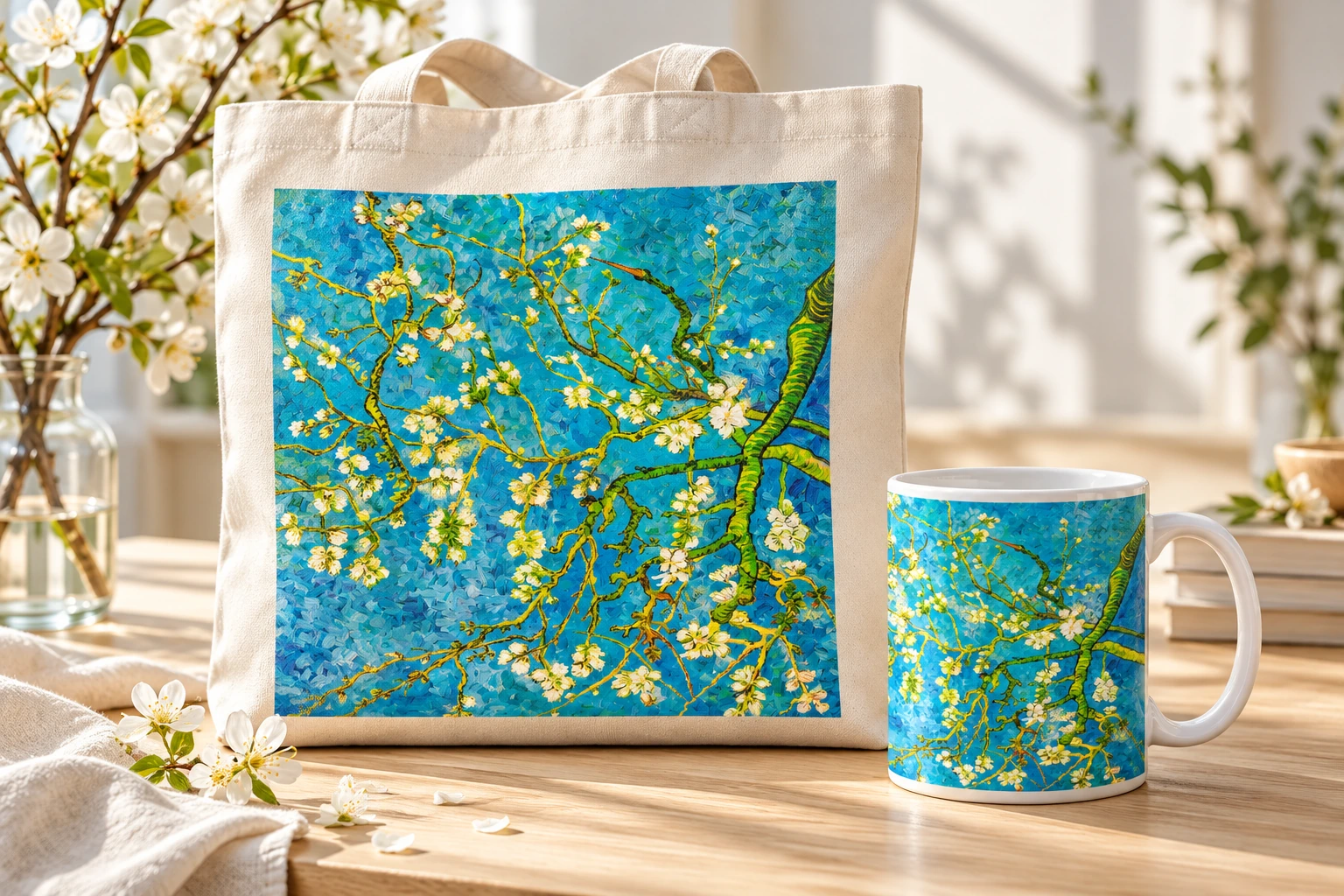
The work “Flowering Branch Embracing Life” on the IMO Meme page illustrates our business most directly. We create new images from the original's colors and forms and expand them into products, spaces, video and 3D expression. The process of reusing an original work itself creates demand for production services.

Starting asset: the original work “Flowering Branch Embracing Life”


① New image | ② Bag and mug product presentation | ③ Framing and spatial application

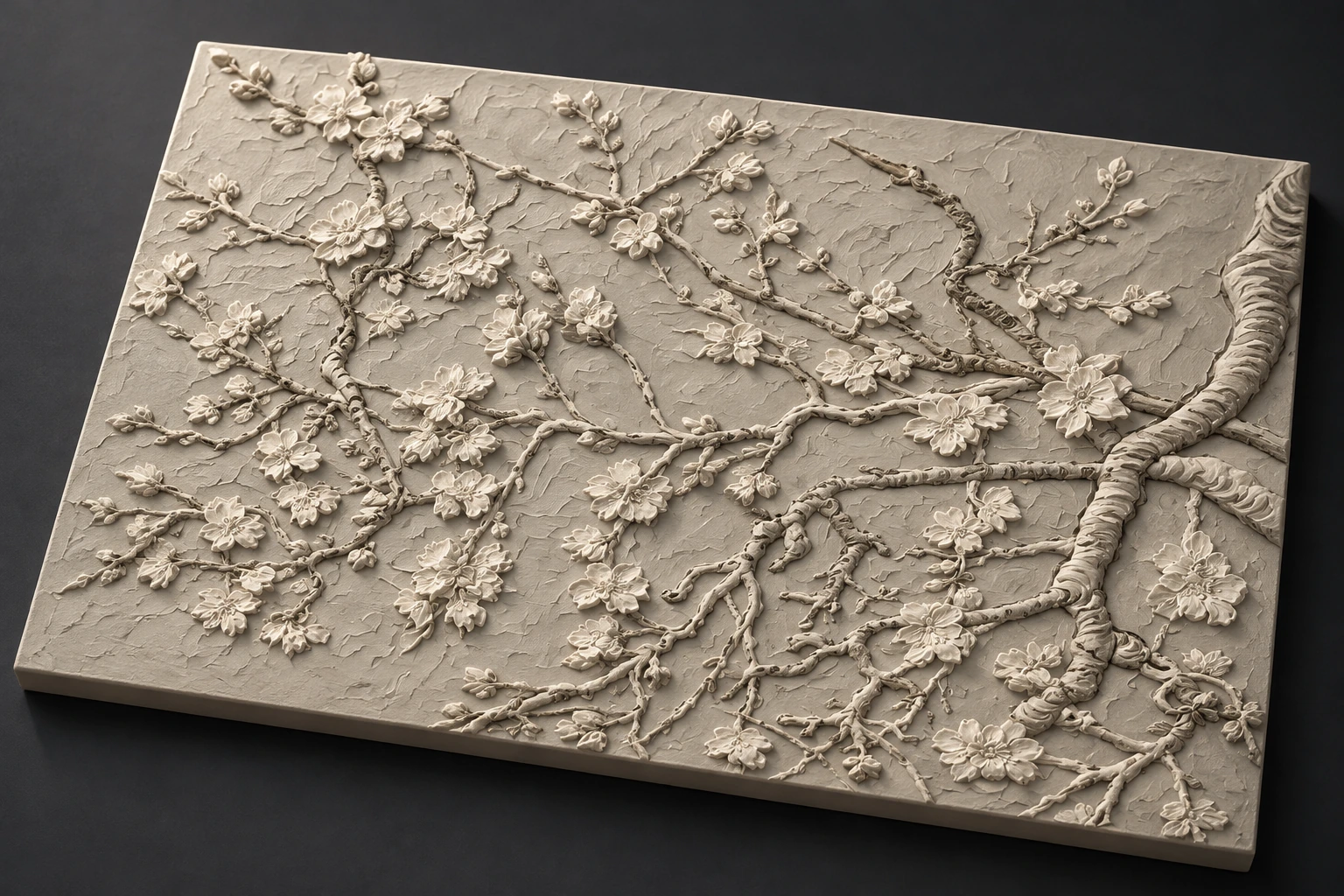
④ Representative frame from the animated flowering-branch video | ⑤ Example of use as a 3D relief
Even from the same original work, a shop seeking promotional images, an individual making a gift, a business placing art in a space and a maker preparing a 3D print need different results. This is why one archive can serve multiple customers and production paths.
All images are original works and usage examples from the existing page. Product photos are illustrative presentations, and video images are still frames. The existence of these examples does not establish physical manufacturing, delivery or sales performance.
4 Saebori turns creativity into business materials

A new presentation of an original work | Promotion for products and shops | My introduction and portfolio
Images and videos
The current studio offers starting points ranging from profiles, imaginative pictures, single-panel comics, social media images, video covers and product photos to short videos, story videos, animated characters, and introductions to shops and groups. Asking users to choose their purpose first reduces the burden of learning tools. Generation, additional editing and delivery of completed files for each task are the units of paid creation.
Websites and portfolios
Pages introducing oneself, pages presenting a collection of works, and group and event introductions are also studio production fields. Connecting image and video results to an introduction page lets creators gather their expressions in one place and helps small businesses prepare foundational promotional materials. Use follows the scope offered on the public screen and the final quotation.
Travel and memory content
Users express travel through pictures, create albums and travel journals, and preserve shared moments in video. Experiences discovered through the travel assistant become studio materials, and completed materials are reused in souvenirs, printed materials and websites. Results carry across services, creating the same user's next need.
This business's competitiveness does not rest only on the number of generation features. It lies in providing a path through purpose selection, planning, reviewing results, revision, saving and production. The company earns income from creation approved by users, while free drafts and samples lower the entry barrier to a first result.
5 Characters leading from free creation to products

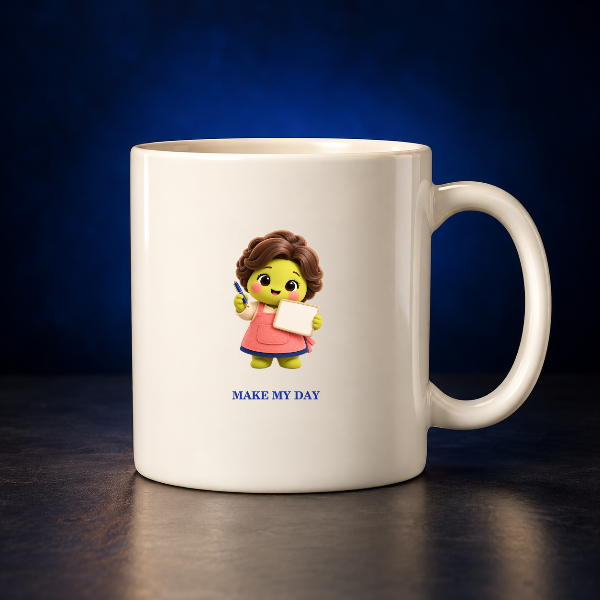
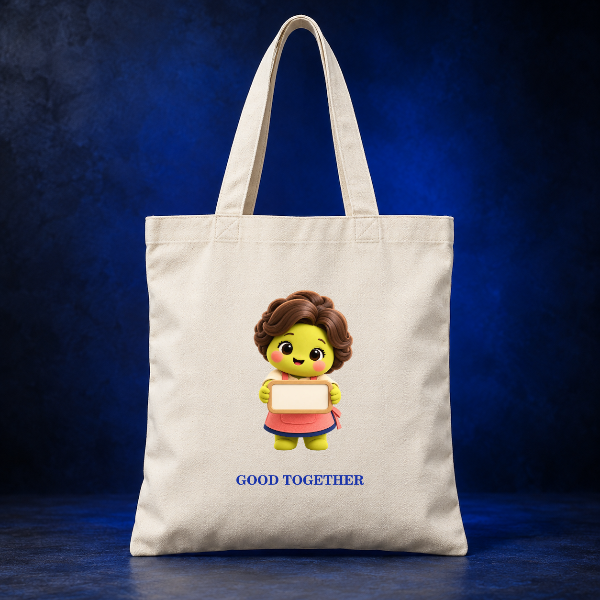
Official Street IMO material | Mug example with added text | Bag example with added text
Our characters become the first materials
Street IMO offers a starting point in stickers and merchandise, Cat IMO in expressions, Cloud IMO in dreams and comfort, and Maker IMO in keyrings and 3D expression. Users begin expressing themselves by compositing official images and changing colors and a short phrase. These materials and editors are brand assets already accumulated.
Making the first result usable in practice
Users position characters and text and adjust their size in free templates for mugs, bags, T-shirts and phone cases. Saving a completed PNG and transparent design is provided so results can be handed over for product production. Free compositing is distinguished from work that incurs repeated AI generation costs.
Remixing and appreciation support the next creation
Works that have undergone public review, remixes beginning from other works, the lineage of original and derivative works, and comments and comparative appreciation build expressive and selection skills. They form a cultural basis for people who discover their tastes to make new works or their own products. The structure does not automatically reward merely generating or posting works or comments.
The role of free access is to let people experience utility first. Income then comes from advanced generation, precision commercialization, print files, physical production and business support. We open a low-cost path for a user's first attempt and let them choose paid creation when they need additional value.
6 From images to 3D production files

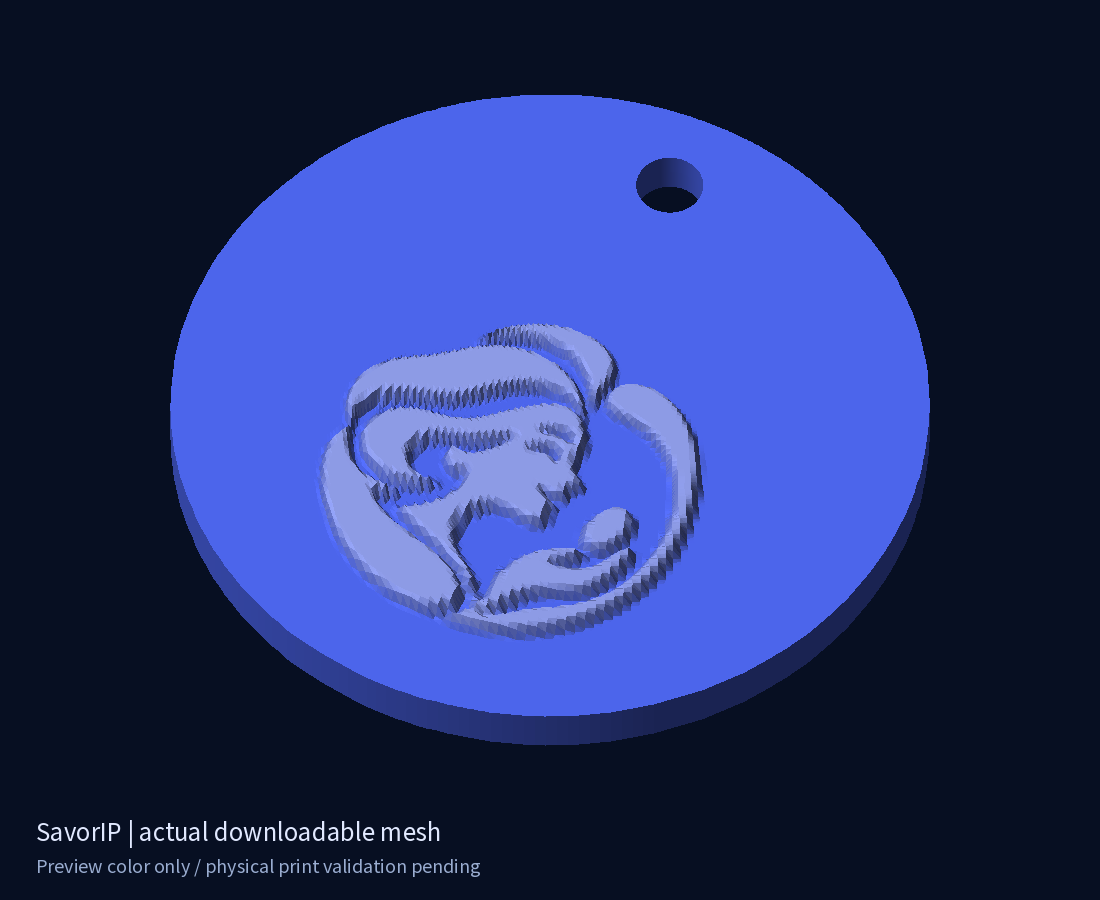
Example mesh for an image-based keyring | 3D master of the existing IMO symbol
3D product creation is based on 2.5D, converting image brightness and forms into height. It connects results with clear production purposes—such as keyrings, nameplates, reliefs and photo light panels—to STL and 3MF files and guidance materials. It is not described as automatically producing arbitrary figurines fully modeled from every direction.
| Current 3D creation items | Point quotation | iMo quotation |
|---|---|---|
| Keyring | 20P | 10iMo |
| Nameplate | 30P | 15iMo |
| Relief and image frame | 30P | 15iMo |
| File for a lithophane light | 40P | 20iMo |
Based on the public production screen. Size choices of 30, 45, 60 and 90mm; STL and 3MF output; free redownload of the same completed file. Physical printing and delivery are separate. The final task quotation takes precedence.
Distinguishing the free symbol workbench from paid new-image creation
The existing IMO symbol keyring provides proportional resizing from a 45×45×3.8mm master with a 4mm-diameter hole. STL, GLB, dimension JSON, drawings and a production recipe are prepared. The free path reusing an existing master and the paid path creating a shape from a new image have different costs and deliverables.
What we sell is concrete preparation for production
The company charges for shape conversion and use of production materials, and extends physical orders through separate manufacturing and printing contracts. Users develop on-screen pictures into files they can discuss with production workshops. Actual print quality and suitability for materials and equipment are checked at the production stage.
7 Four production workshops for everyday life
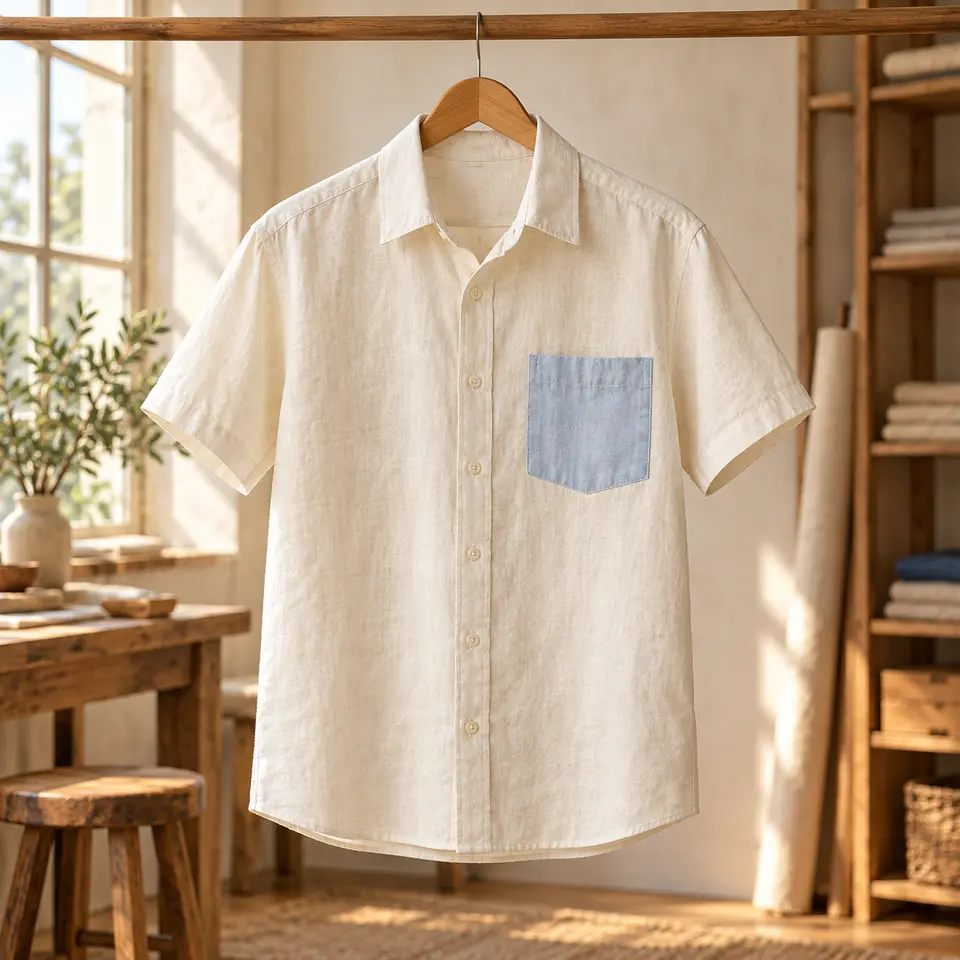

Draft designs for clothing and alterations | Measured spaces and furniture layouts
Illustration: input dimensions and panel calculations in the basic shelf model
Diagram reproducing linked dimensions in the basic shelf model: overall width and internal board length change together
Clothing and spaces
Clothing designs use front and back views, sleeves, colors, pockets, dimensions and production notes to create starting materials for alterations or shop uniforms. Spaces connect actual room dimensions and furniture arrangements to floor plans, furniture lists and DXF. This business moves from free design drafts to AI visualization and production consultation.
Household items and inventions
Household-item tools design shelves in the required dimensions and create board lists and STL and DXF files. The invention field explains the basic structures currently supported through front, side, top and exploded views. It is a feature for making ideas concrete, not one that automatically assesses patentability or files applications for every invention.
In the actual shelf tool, changing the width from 800mm to 900mm also changes the internal board length from 764mm to 864mm, reflecting the 18mm thickness. Its technical significance is handling dimensions, parts and files consistently, beyond producing an attractive image.
SVG, DXF, STL, editable JSON and print PDF are provided for different purposes. These design drafts support production communication and lead to paid demand for visualization, materials, processing, professional review and physical production. Engineering verification of structural loads and joint safety is separate work at the production stage.
8 Product workshops for memories and accessibility

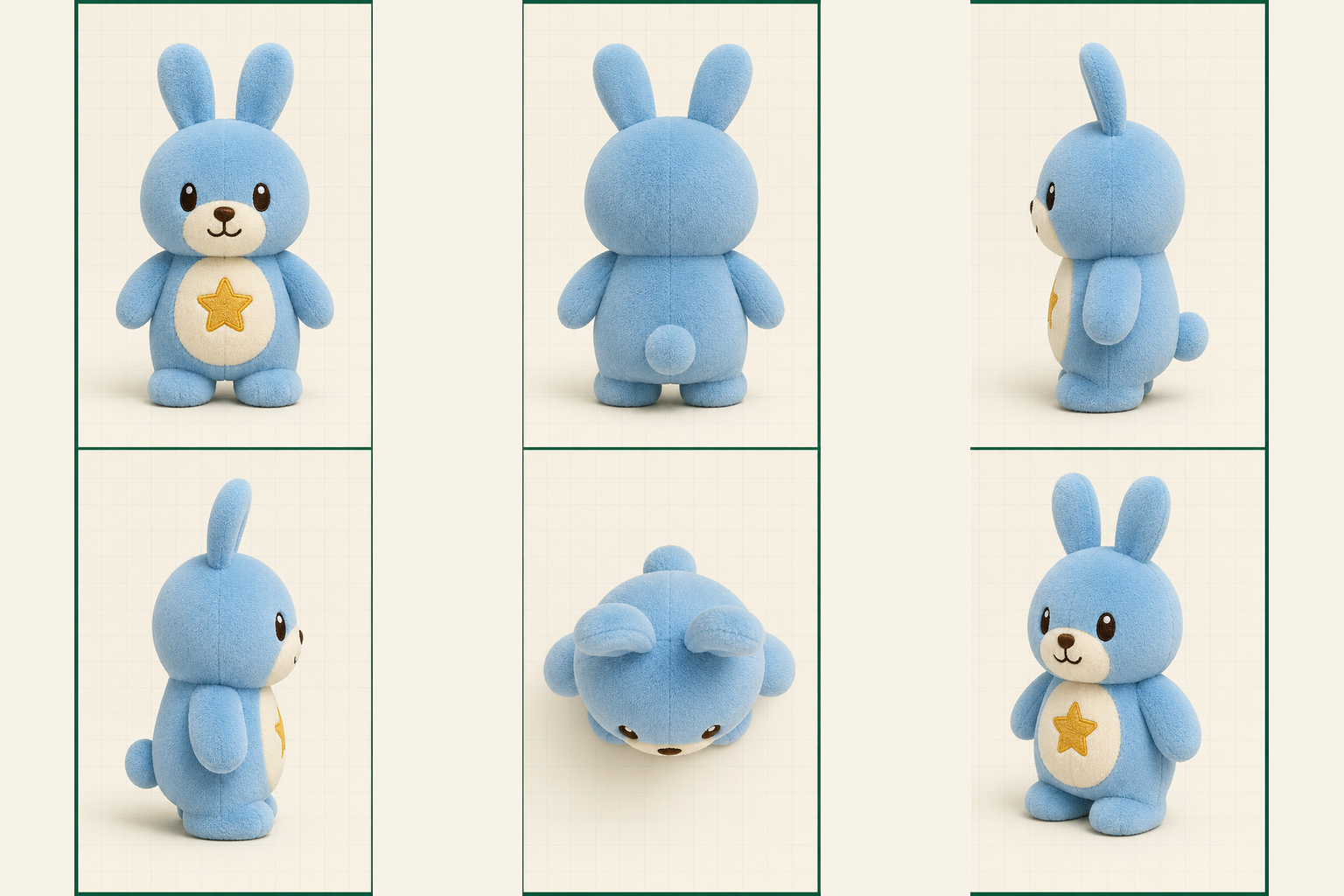
Existing studio image from the Children's Memory Workshop | Six-direction concept views explaining a shape to a manufacturer
Children's Memory Workshop
SAVORI KIDS MAKER WORKSHOP develops children's drawings into concepts for dolls, toys, notebooks and 3D products. A structure is prepared for viewing the product's appearance and proceeding to six-direction production concepts and PDFs for parents and manufacturers. Its purpose is to turn children's expression into assets families can preserve and give as gifts. The public configuration displays 3P for creating a product appearance; physical production requires separate confirmation by the guardian and manufacturer.
Travel memory products
Travel photos and stories become postcards, acrylic cards, frames, print PDFs and commemorative products. Experiences enjoyed during travel can thus be preserved and shared afterward. The company can earn income from digital production files, printing and processing, souvenir production requests and support for bulk orders.
Helping everyone complete their own expression
- Describe an idea aloudStart with your voice
- View it larger and checkRead in larger text
- Approve it as you intendConnect to production materials
Diagram of the accessible creative-support process
Accessible creative support
Voice, large text and step-by-step artist approval are combined so people do not have to give up creating because of age-related near-vision difficulties, limited hand movement or difficulty with digital tools. A structure is prepared in which basic work plans and My Storage help users start, while artwork descriptions, QR stories, commercialization packages and professional assistance connect to paid support. This business reduces the burden of carrying out work while preserving artists' wishes and rights.
Completing work with manufacturers
Manufacturer pathways connect printing, frames, acrylic products, everyday merchandise, spaces, corporate gifts and bulk production. Digital concepts are materials for discussing specifications with manufacturers. Quotation approval, feasible materials and specifications, deadlines, delivery and responsibility for defects are determined for the actual order.
These three markets use the same tools for different reasons. Families purchase the meaning of memories, travelers the preservation of experiences, and accessibility-support customers help in completing their own expression. The structure reuses a common production foundation while charging for the support each customer needs.
The workshops and packages in this chapter are business assets identified in the studio's public configuration. The current initial screen centers on images, videos, websites and travel, while the public availability and pricing of detailed workshops follow the final service quotation.
9 Artworks used in shops and spaces
Example of framing the original work
- A QR code beside the artworkDiscover it on site
- Read in my languageArtwork descriptions and stories
- Product and production inquiriesChoose the next use
Diagram showing artwork descriptions leading to discovery on site and subsequent use
Artwork recommendations and My Shop
Users select archive works that suit a space's atmosphere and colors, then arrange works and products to create a shop presentation. The basic arrangement helps with the first decision and connects shop-atmosphere images, production-proposal PDFs and manufacturer consultation to paid creation. The public configuration lists 18P as the reference for a shop image.
Space previews and artwork rental
Users place works in photos of homes, cafés, accommodations and offices to review size and atmosphere. This can expand into high-resolution production files, printing and installation quotations, artwork sales, and rental, replacement and management. Rental income entails the costs of actually securing, transporting, installing, storing, repairing damage to and collecting works. Contracts and installation results are disclosed only to the extent actually established.
QR artwork stories and on-site customer connections
A QR beside a work provides a pathway to multilingual artwork descriptions and stories and inquiries about related products and campaigns. The place where a work is viewed becomes a sales contact point for discovering artists and products. The public configuration lists artwork descriptions and QR stories from KRW 19,000 per work and commercialization preparation packages from KRW 49,000 per work. Professional assistance is quoted separately.
Space owners obtain presentation and customer-explanation materials, while artists gain opportunities for use and discovery. The company receives payment for files, descriptions, commercialization, installation and management. This business generates income from work with clear deliverables and costs.
10 Turning intellectual curiosity and personal stories into assets

Existing webtoon portal image for discovering stories across genres
Webtoons and the creator economy
Webtoons are both a cultural service for enjoying and relating to stories and a content business in which creators register and sell works. A public structure is prepared with genre discovery, episode access and purchase rights, creator registration, electronic contracts, rights declarations, AI-use declarations and revenue ledgers. Income from finalized transactions is settled in service points, with a default split of 30% to the company and 70% to the creator. Fractions in the company's share are rounded down.
There are 12 genres: romance, fantasy, drama, comedy, slice of life, action, thriller, horror, SF, historical, sports and healing. All 40 currently published episodes of “Grandpa Yeongjo” are free. Having paid-episode payment and creator-settlement structures prepared is distinguished from actually generating paid revenue. For example, a finalized paid 10P transaction is divided into 3P for the company and 7P for the creator in service points. The creator's share is in service points; cash settlement is not currently provided.
- Episode transaction10P
- Company share3P
- Creator share7P
The 40 published Grandpa Yeongjo episodes are currently free. Creator shares are service points; cash settlement is not provided.
Example point allocation after a transaction is finalized, distinguished from currently free episodes
How my story becomes a result I can keep

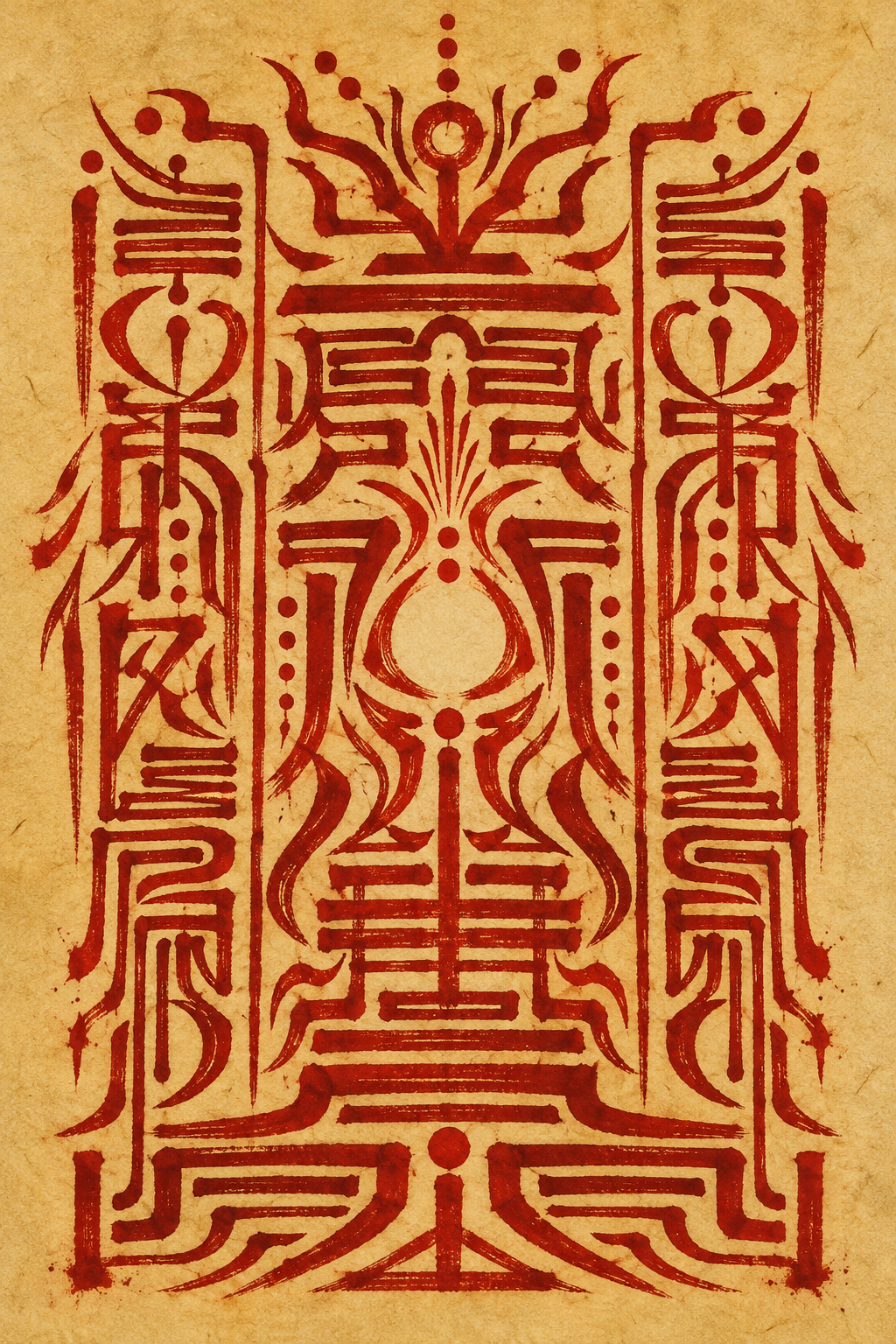
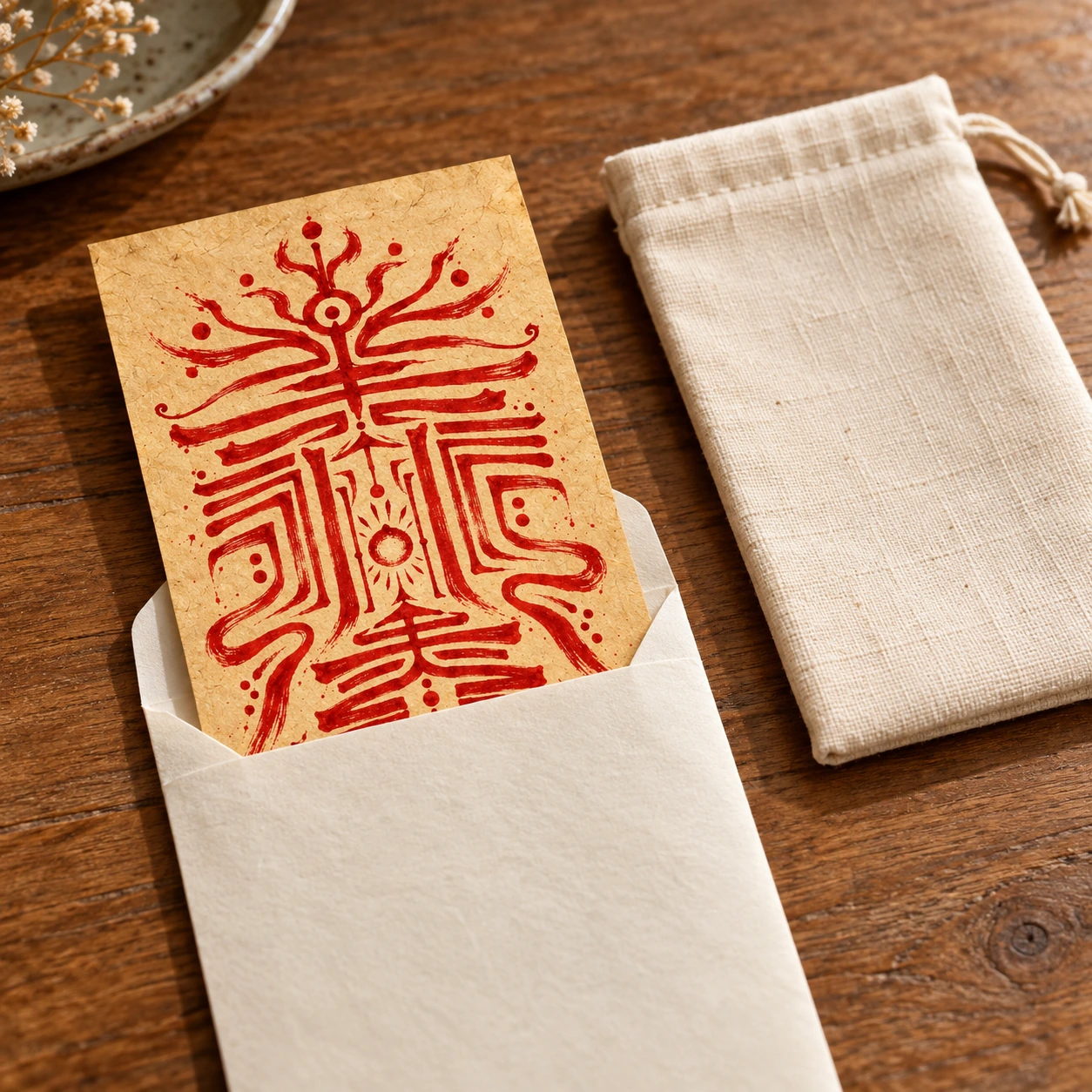
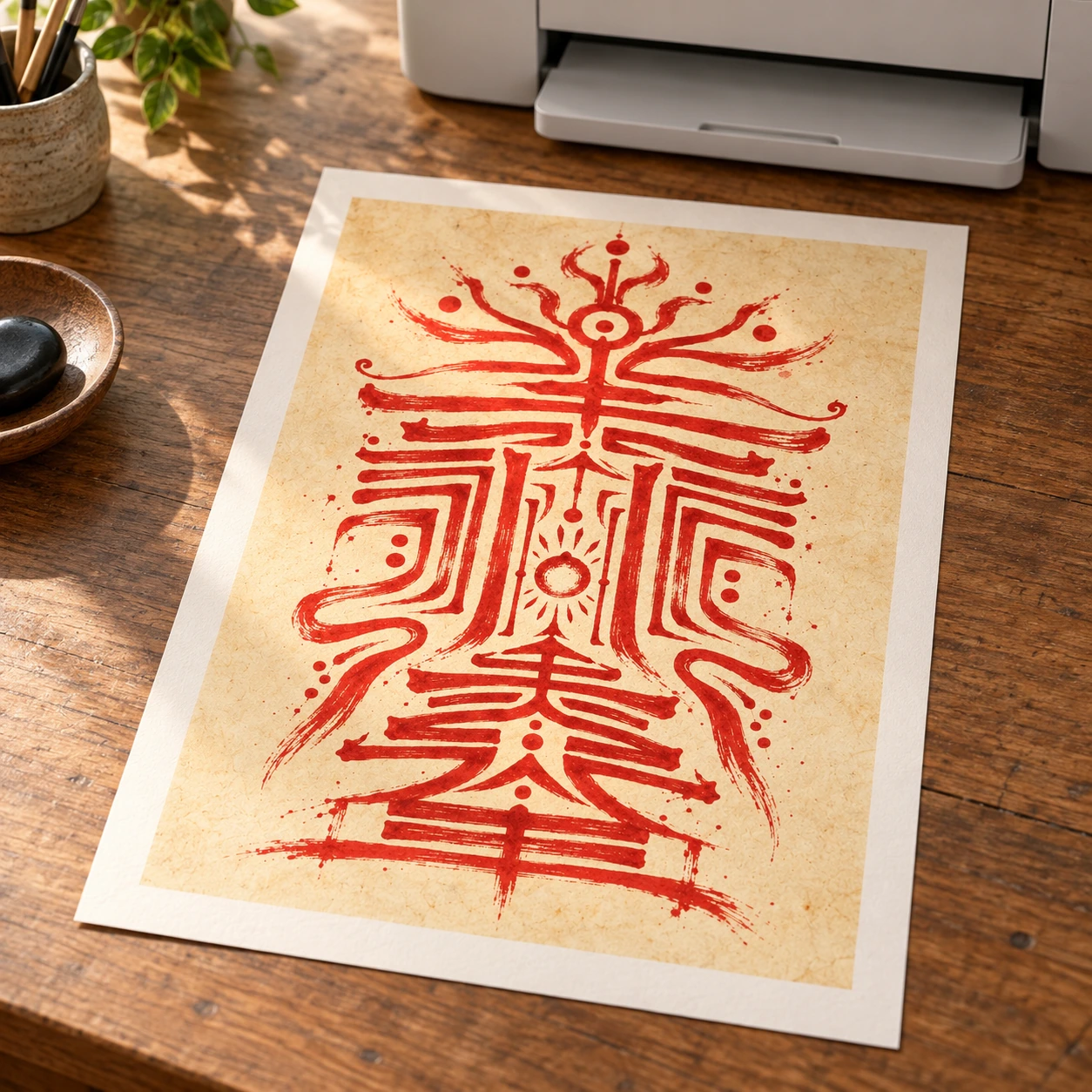
Wolha | Pattern style | A form to keep | Print use
Existing talisman-style, storage and printing examples. Different samples are not presented as before-and-after production results for the same member.
My Destiny and talismans
The different perspectives of Wolha, Astra, Seonjae and Doyun organize concerns and tendencies, birth information and life experiences into stories. Free stories lead to the creation of personal outputs such as a final destiny story, self-assessment, talisman, future appearance and print PDF. Users obtain meaningful expressions beyond simple answers, and the company earns income from additional creation they approve.
The value in this area is intellectual interest, self-expression, immersion in stories and emotional satisfaction. Cultural interpretation is offered as content whose meaning users can choose and preserve, rather than packaged as objective prediction of the future. Viewing and comparing webtoons and artworks also provides material for new creation.
11 Programs that connect memories and reflect on everyday life

MY OTHER SELF / LEARN · RECORD · REVIEW
Review relevant memories and verified information.
- Observe
- Record
- Understand
- Choose
- Act
- Observe again
Records I have checked
A visualization of the learning process, not a measurement of actual brain activity
Knowledge materials exploring the body and brain | Existing diagram connecting observation, recording, understanding, choice and practice
Brain image source: BodyParts3D / DBCLS · CC BY 4.0. The original attribution is retained.
My Digital Self
Users explore maps of the body and brain, then learn, record, take small actions and reflect. Photos, videos, personal memories and AI explanations are gathered in personal storage to connect their interests and records. Interests such as memory, skin, meals, exercise and cellular aging provide starting points. This is a personal service for expression and understanding through selected materials, not a feature claiming to replicate human consciousness.
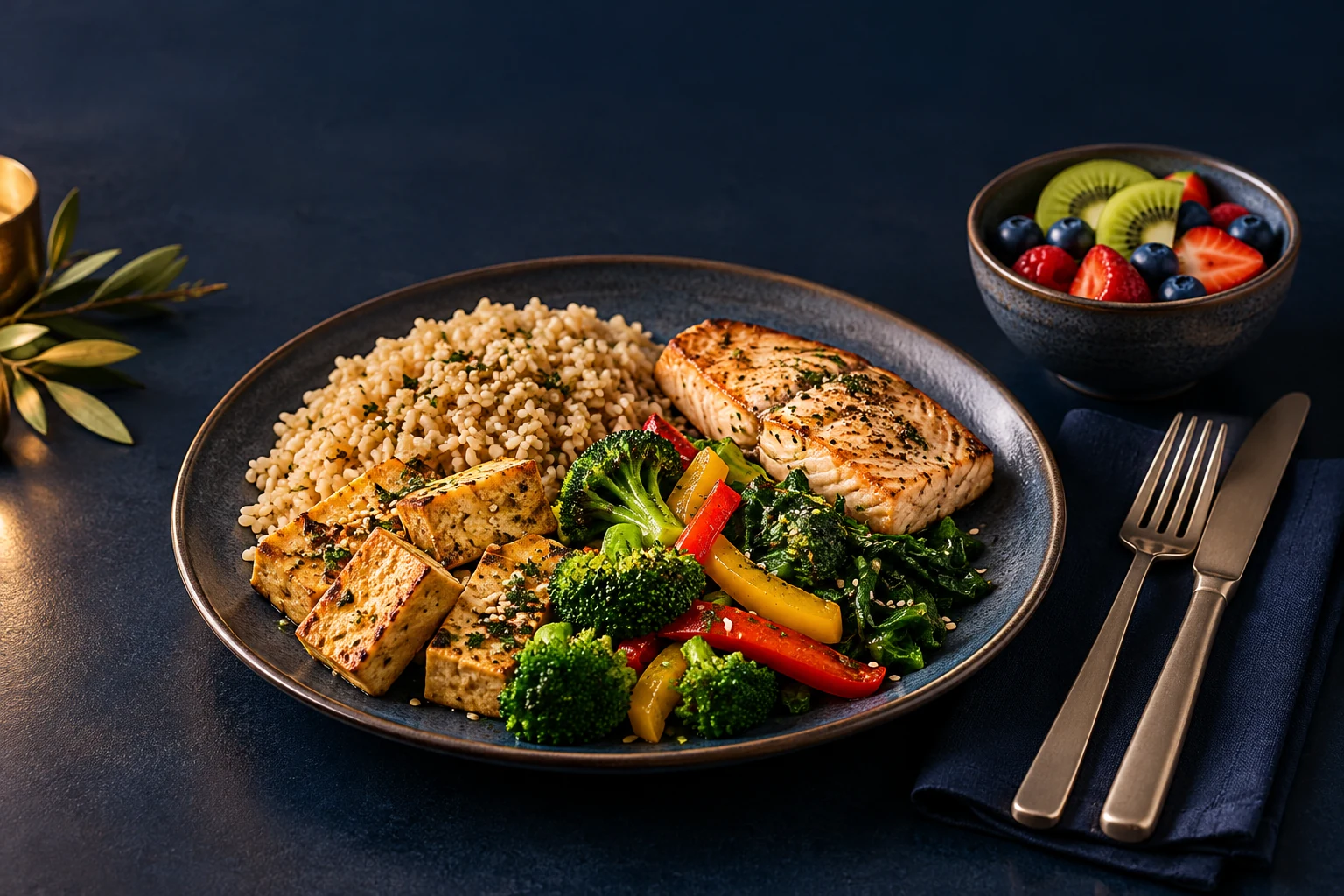

Meal topics in everyday plans | Materials for reflecting on food and everyday life
Vitality and everyday care
Users explore 3-day and 7-day meal, movement and lifestyle plans from interests such as skin, vitality, recovery, muscles, memory, metabolism and intimacy. They separately record actions taken and their own perceived responses. Current experiences are open for free, with an expansion path toward customized images, new videos and personal-care products as additional creations. The service is not described as having proven therapeutic or anti-aging effects.
Donguibogam as everyday knowledge and creative material

Existing introductory image exploring classical and everyday knowledge


Materials comparing rice, barley and red beans | Choosing and understanding everyday ingredients
Donguibogam as knowledge for today
Users explore cultural materials from Inner Body, External Form, Miscellaneous Diseases, Medicinal Substances, and Acupuncture and Moxibustion, alongside body, organ and daily-life topics in today's language. Classical knowledge, modern official evidence, everyday care and signs to seek medical help are distinguished so curiosity leads to learning, records and story creation. This forms a basis for repeat use of personal records and optional output creation.
These programs broaden IMO Meme's utility even when users are not immediately making products. Learning, memories and tastes give users reasons to stay and return and provide context for later personal outputs and creation. Operations are designed for users to choose what to store and send to AI and to check additional AI costs before execution.
12 Travel and Together connecting Korea and the United States

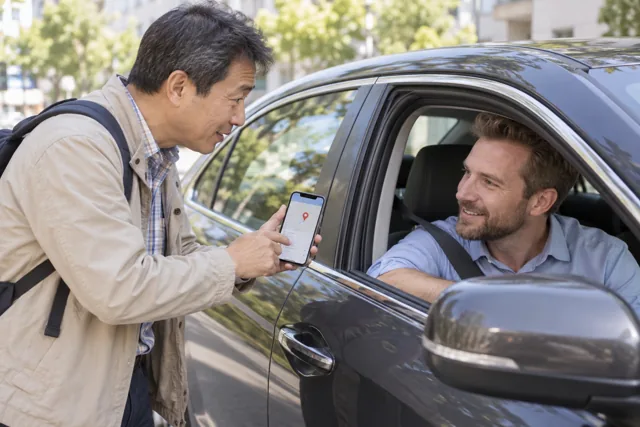
Understanding places as a foreign visitor to Korea | Showing a destination address to a driver in the United States
A service that saves travelers time
IMOHELPER connects on-site needs—places, food, accommodation, shopping, transportation, experiences, communications and luggage—to conversations and explanations. Menu-photo and language comprehension, finding places and directions, travel planning and Together connect with one another. Foreign visitors to Korea and Korean-speaking users traveling in the United States can use information about unfamiliar places to make their own choices.
Connecting before, during and after travel
Users plan around accommodation and cities and, after arrival, understand addresses, conversations, transportation, menus and bills. They share possible places to go together and leave photos and stories during their travels. These materials lead to Saebori albums, videos and commemorative products, turning travel experiences into reusable creative assets.
Shared needs arise when people gather
In Together, people share languages and tastes, give and receive help and discover things to do together. The company generates income from selected additional creation, advertising, business information and work tools. Travel discoveries, human relationships, creation and local businesses' customer contact points share one service foundation.
The separate US portal provides support tools for addresses, conversations and records. These are at a different stage from actual booking agency services or paid US advertising delivery. The following scenes distinguish current features from expansion possibilities.
Moments when IMO helps during US travel
From departure preparation to arrival at a US airport and local everyday life, concrete tools help with moments when travelers stop because they do not know what to do.

① Prepare transportation and destination at the airport | ② Show and communicate an address to the driver
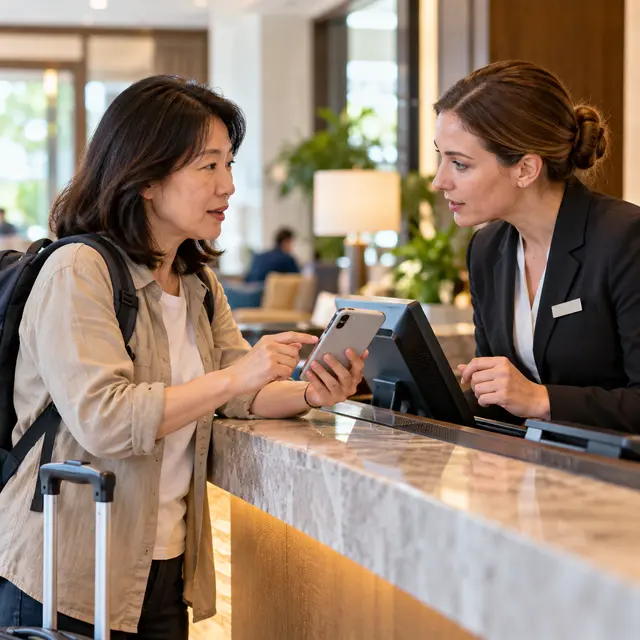
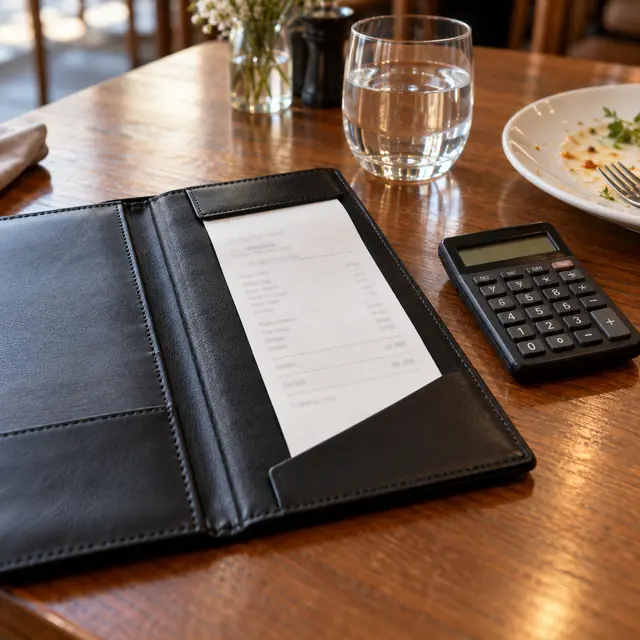
③ Understand necessary phrases in Korean and English | ④ Distinguish taxes, service charges and tips on a bill
Users find places around a location, city or accommodation and choose walking, Uber, car or public transportation and a time range. Separate screens are prepared to support local Korean–English conversation and listening, offline viewing of accommodation addresses, saving and exporting travel files, and visa-preparation checks and PDFs. Topics also extend to understanding schools, local life and vehicle contracts.
These are illustrative images from the existing US service. The public city configuration includes LA, New York, San Francisco, Honolulu, Las Vegas, Seattle, Chicago and Anchorage, with screens in 6 languages. Map handoffs are distinguished from direct booking and real-time route verification. US advertising is a display example using places within about 3 miles; paid delivery is not currently provided.
Together gives members a reason for their next visit

Existing Together interaction scene sharing interests and places


Conversations read in each person's own language | Preserving shared experiences as photos and creative materials
Starting from going together, sharing and trading, event invitations and help with questions, the service leads through public recruitment, participation requests and approval to individual and group rooms. Users read in their own language, share photos and files, ask IMO about places, review answers and share them. Collected materials can connect to memory creation in Saebori.
For teenagers too, interests such as drawing, webtoons, music, languages and travel give reasons for conversation and collaborative creation. Members gathering around shared interests can expand their use by making club posters and characters, short videos and commemorative designs together. These relationships add a reason to return to the experience of using a tool alone.
The free pass connects Korean stories, webtoon conversations, making things together and confirmed free experiences, with a structure for checking the facilitator, age group, time, place and capacity. Photos depict virtual experience scenes and are not evidence of actual youth gatherings or events held.
Markets opened by what people create together


Sharing stories of interest | Choosing places to go together | Shared experiences in local shops
- Together roomA space to share interests and languagesReturn visits and relationships
- Co-creationStickers, posters and productsGeneration and product creation
- Places to visit togetherRestaurants, cafés and cultural experiencesAdvertising and business support
Business relationships leading from interaction to collaborative production and local businesses' customer contact points
The value of gathering members goes beyond registration counts. Results chosen together, repeat production commissions, shared questions about places and actual intent to use them represent the next demand. The company provides generation, files, commercialization and business services, while members accumulate their relationships and expressions.
For example, a room sharing drawings could make club T-shirts, friends reading webtoons could create posters, or a travel-planning room could explore menu and transportation information for the same place. These scenes are usage examples. No mandatory sequence forces every room to lead to a purchase or advertisement.
Advertising at the moment of need becomes a business contact point


① The owner prepares photos, descriptions and prices | ② A customer with a need discovers a nearby shop


③ The business responds to inquiries and reservation requests | ④ Welcome customers and check usage status
When travelers seek somewhere to rest or eat, understanding distance, menus, prices and how to use a place helps them choose. The publicly described Korean connection structure recognizes needs for dining, cafés, shopping, accommodation, experiences and transportation in conversation and asks whether to find information within 500m. Selected information leads to advertising or affiliate labels, business details and inquiries.
Shops gain an opportunity to explain themselves to interested customers, while members obtain information for choices they need to make now. The company builds a business receiving payment for advertising delivery, menus, multilingual descriptions, promotional materials and business tools. Inquiries, business replies, time changes, confirmation and visit status are managed as the performance flow after advertising.
The four photos are existing AI-staged images with the same shop and characters continuing across them. They are not presented as actual advertisers, customers, reservations, visits or sales performance.
Who pays for what
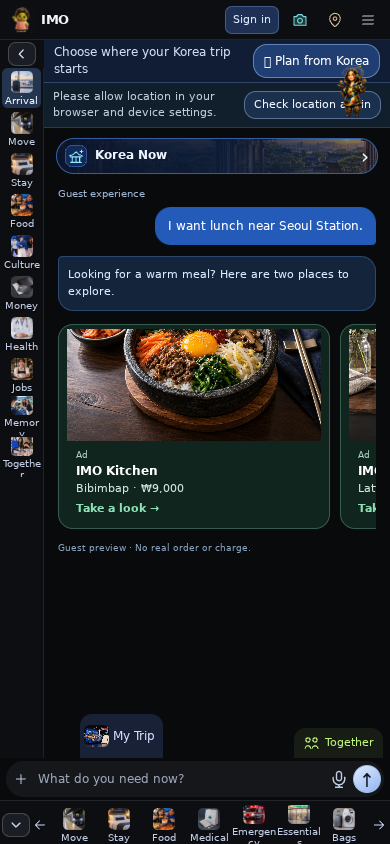
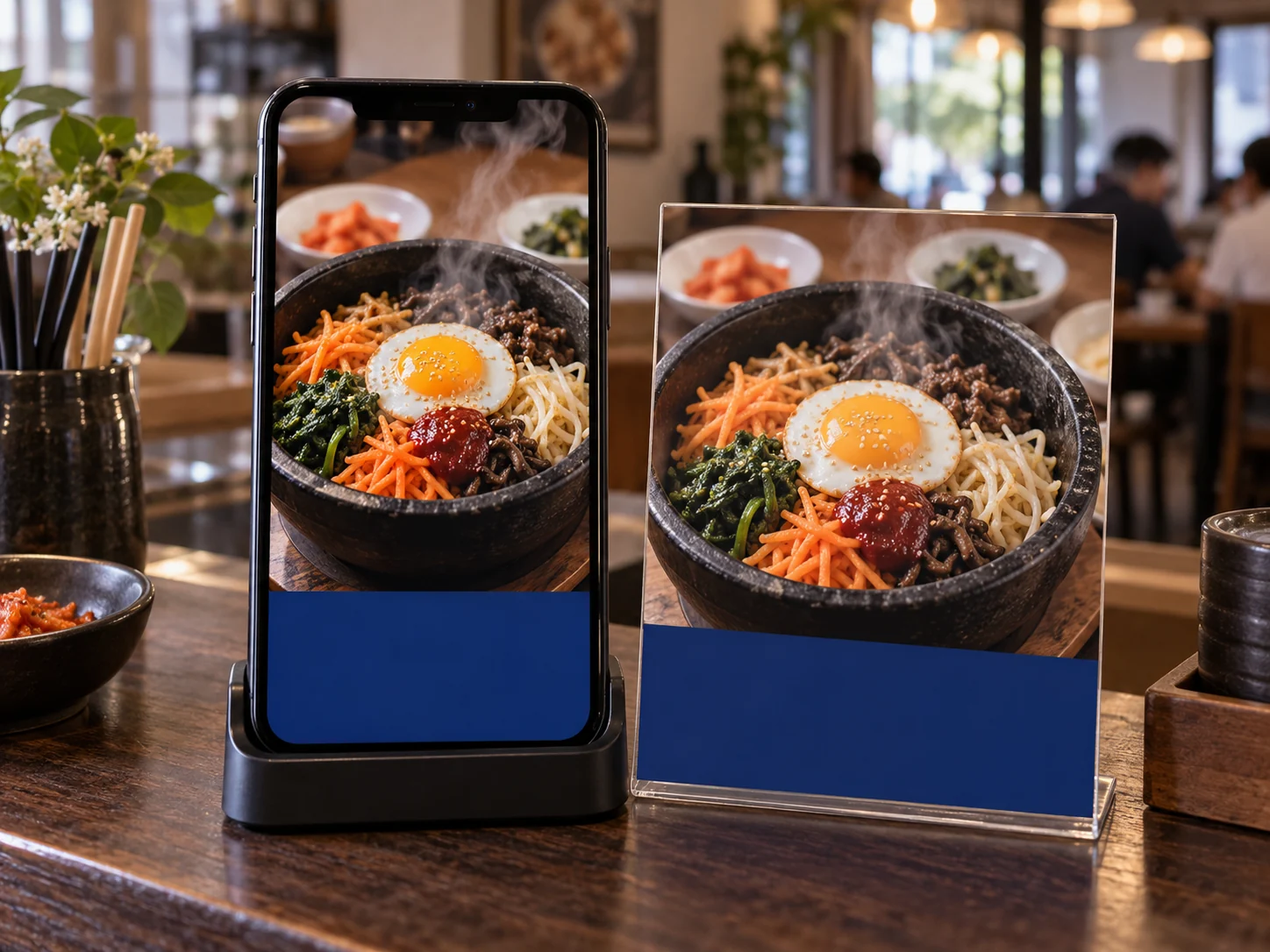
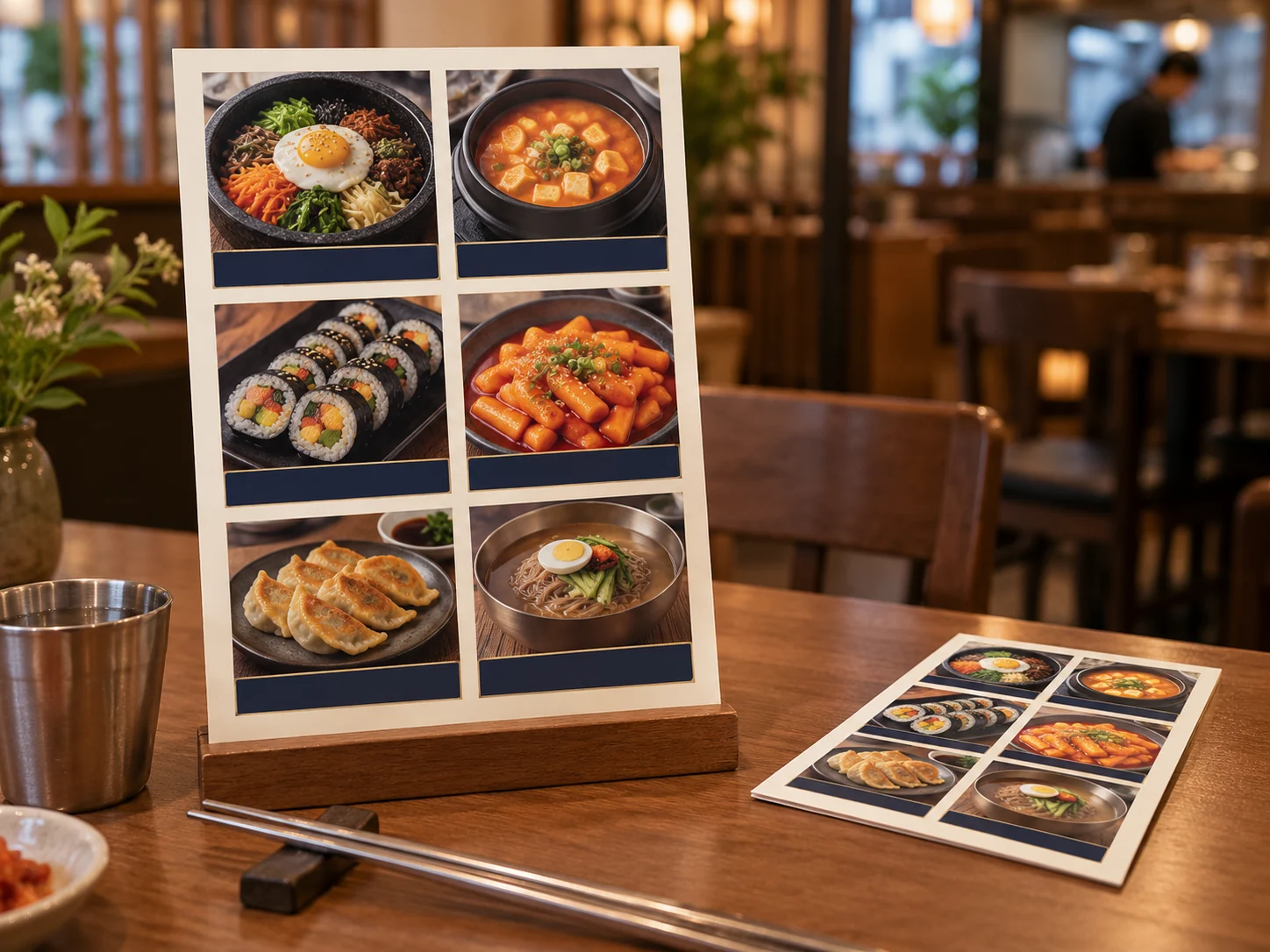
Existing guidance screen with an advertising label | Advertising output created by a shop owner | Menu materials made from photos and descriptions
Diagram distinguishing customers' menu payments, advertising budgets and payments for creation services
The existing advertising management screen explains 500m proximity advertising, a daily deduction at the first valid impression that day, and advertising C budgets, pausing and usage history. Advertising C is separate from P used for creative services. The KRW 9,000 on screen is the customer's menu price, not an advertising fee. Photo uploads and basic editing also have a different service scope from paid AI and additional-language creation.
New pricing based on valid detail clicks is in preparation; unit prices and the effective date will be announced separately. The current impression-based model and the forthcoming click-based model are not combined into finalized terms charging both simultaneously. Actual daily advertising fees, contracts and receipts follow the relevant advertiser-management terms.
Broader revenue opportunities within Together spaces

Creative materials made with brands | Information for discovering local shops | Output materials needed for collaborative production
Sponsorship suited to the topic
An expansion could have brands sponsor defined creative experiences and challenges around drawing, webtoons, music and culture. Members join activities they choose, while businesses pay for specified creation, operation and exposure work. Advertising and sponsorship are clearly labeled.
Collaborative production for clubs and groups
Developing a character made together into T-shirts, stickers, posters and videos broadens demand from individual creation to group orders. Generation, production files, commercialization support and actual production orders can each become work performed by the company.
Local business services for travel and everyday life
Needs for food, experiences, transportation and spaces arising in travel-planning rooms and on-site conversations can lead to business information, multilingual materials, advertising and partnerships for actual use. In the United States, the path prepares paid delivery and settlement based on current tools and free advertising examples.
These are expansion ideas, not records of existing paid contracts. As people's interests and shared needs change, new creative, information and business services can arise to address them. Together is a space where these possibilities are discovered, and IMO Meme supports opportunities to participate in the next creation.
These expansion paths connect to the business-service and creation income in the following revenue model. The same production work and contracts are not counted again as separate sales.
13 Artwork markets and participant networks
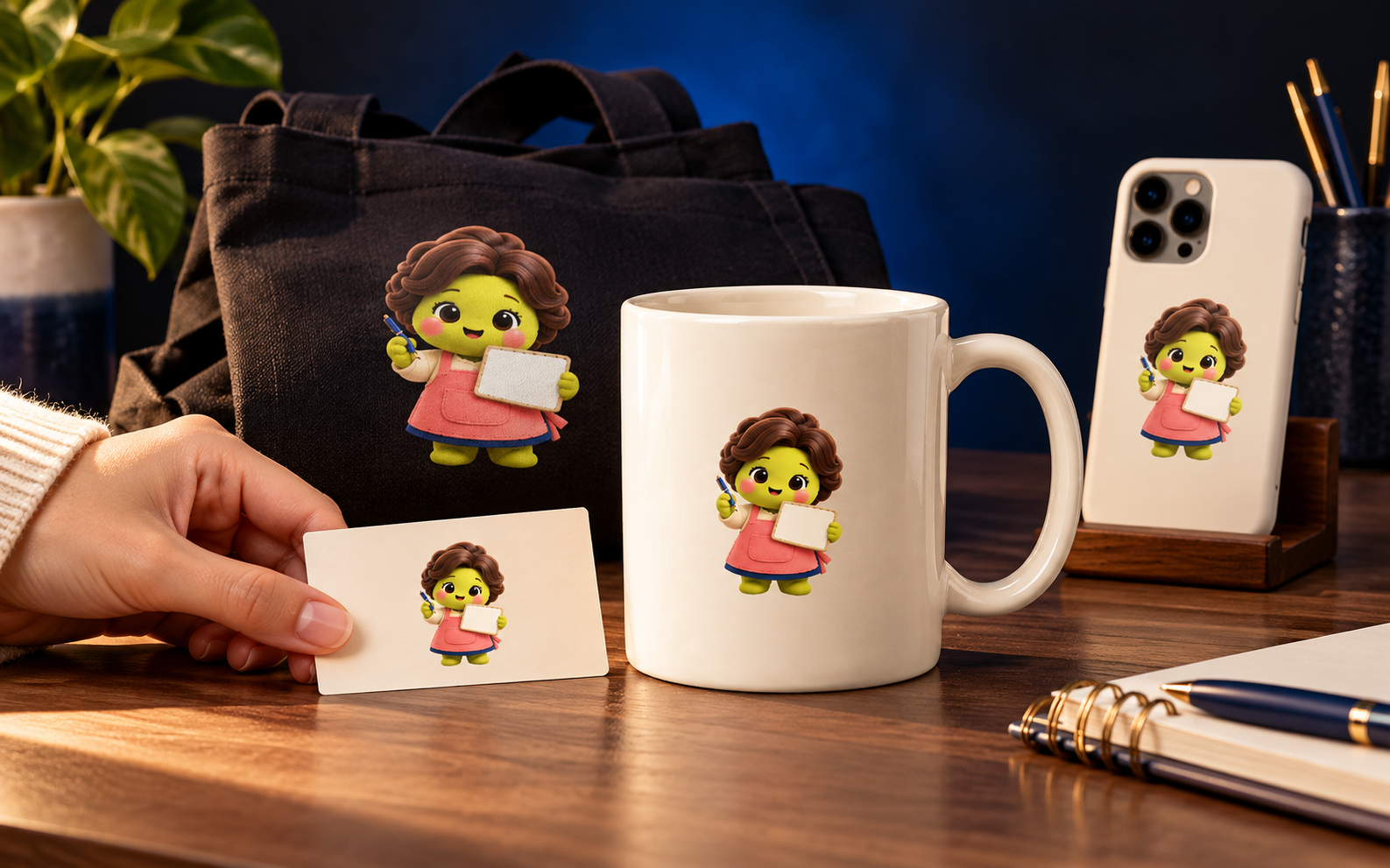
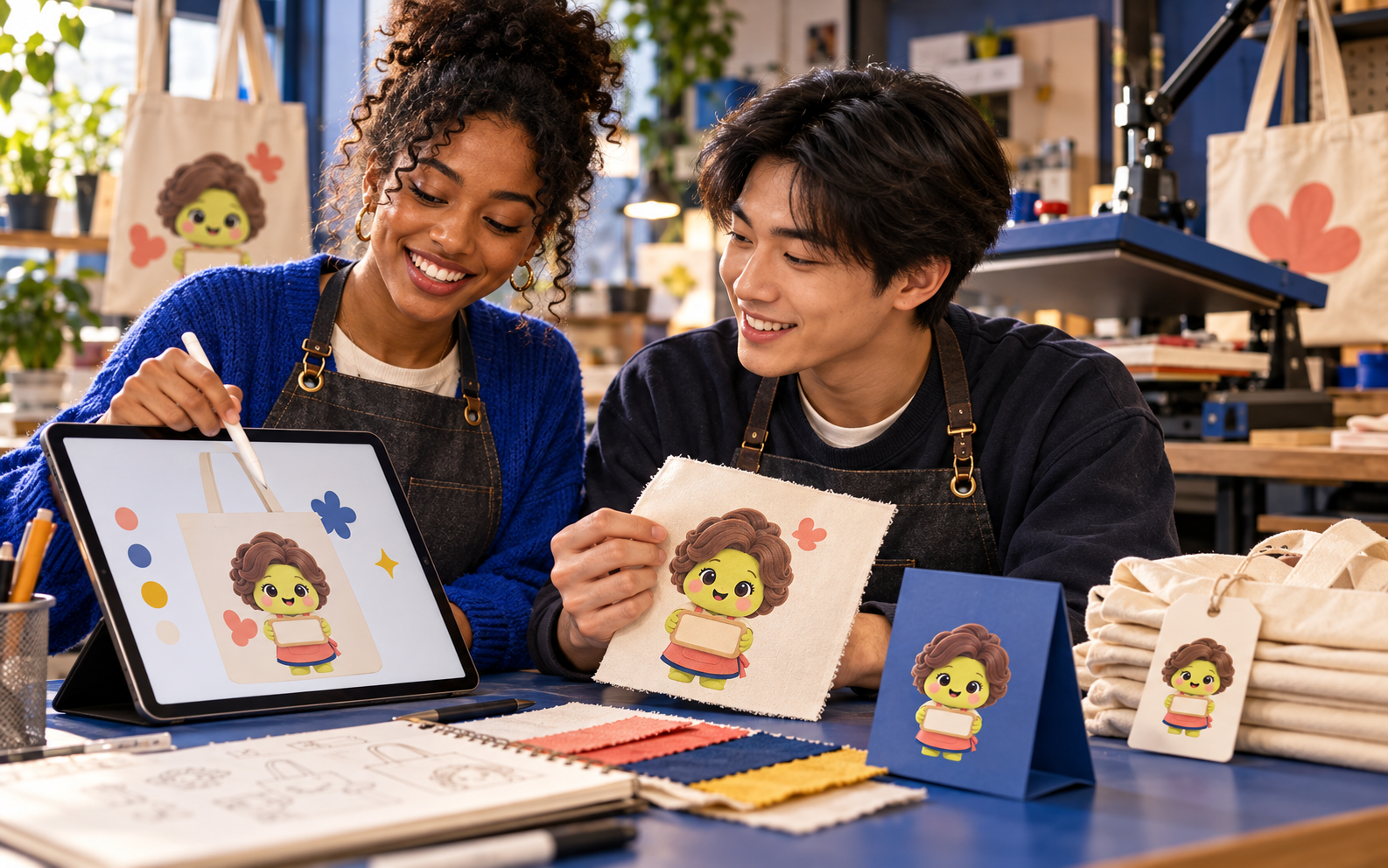
Creative MARKET's direction for commercializing artworks | IMO Partners: creating and promoting together
Creative MARKET
It connects archive viewing and artwork recommendations, comparative viewing, direct creation, saving one's own images and desired prices. Discovering a work is the starting point for commercialization. Saving a desired price currently prepares for sale; it does not complete payment or delivery. Pathways to later income from actual sales, artist usage rights and production brokerage are retained.
IMO Partners
It provides personal introduction links and QR codes, counts of consenting visitors and a view of one's own activities. It forms a foundation for creators, manufacturers, shops and promotional participants to introduce suitable works and services. Separate rewards for sharing or clicks and paid campaigns are not currently provided. Expansion to defining compensation for contracted campaigns or actual customer connections proceeds on top of these tools.
- Artwork and rightsThe original–remix relationship
- My creation and saved workUse it as my output
- Commercialization and marketsPrepare for sales and production
Artwork usage paths have a different purpose from member-to-member token trade proposals in IMO Market
IMO Market
This is a separate bulletin board where members propose terms for trading freely received IMO Meme. Members transfer directly from their own accounts or wallets; the company does not hold payments or provide automatic exchange. Point trading is not provided either. Creative MARKET, which commercializes artworks, and the IMO Meme trade-proposal space differ in purpose and responsibility.
The glossary of images, products and forms explaining basic features, My Works, point history and the Refund Center are also assets of this economy. There is also a member-to-member transfer pathway for gifting points using a member number and quantity. Users must be able to keep their results and understand costs and rights for their first creation to lead to repeat use and trust.
14 Expansion businesses leading to the next experience
- Gift products and QR codesShare art and sentiment
- Messages and iMoExperience after member verification
- The recipient's creationConnect to the next creation
- Original artworks and charactersExisting creative assets
- Source files for supported devicesConvert into three-dimensional materials
- Experiences in physical spacesAR · VR · XR
Relationships in preparing QR gifts for expansion | Relationships in preparing expansion into device experiences
QR gifts
A personal message and specified iMo quantity are connected to a mug or product made with one's own drawing. The concept is for recipients to receive both the object and the sentiment and, after member verification, enter a new creative experience. It connects product production, personal gifts and use by new participants. It is currently being prepared for expansion, and the public QR example is not an actual receipt process.
AR, VR, XR and holograms
Existing artworks, characters and 3D masters are expanded into source materials for supported devices and spatial experiences. The business also includes preparing decorations, figurines and 3D source materials from IP images and connecting printer requirements with manufacturers. Instead of creating a new original work every time, accumulated materials are used in other ways of experiencing them. Device-compatible production and experience content provide additional-creation income paths. This is currently in expansion preparation and does not mean separate hardware sales or completed implementation of holograms.
Restaurants and offline use
The public preview of converting iMo into service points and choosing a restaurant menu is an asset exploring everyday use beyond creation. It is currently an image demonstration and does not execute actual orders, payments or exchanges. If merchant participation, settlement and service-provision funding are secured in the future, it can lead to actual use with travel and local businesses.
The business meaning of expansion
We aim for a path in which someone who starts with a free character makes and gives products, takes photos while traveling and reuses them in the studio. The more users move between services, the more we can reuse the original works, tools, explanations and account foundation already prepared. IMO Meme provides reasons to participate in these connections and support for the next creation.
The features, content and production masters prepared are a development foundation for subsequent businesses. By adding product delivery, device compatibility and on-site use to current experiences, we bring our assets to new customers and uses.
15 Where income arises and the basis for prices
The company's income arises from outputs and work chosen by customers. Free iMo distributions themselves and member-to-member token movements are not counted as company sales. The following brings together all income paths in the business configuration connected to the public pages.
- Generation, production and filesPayment for creating outputs
- Product and IP supportPayment for enabling use
- Content and spacesPayment for artworks and experiences
- Advertising and businessesPayment for customer touchpoints
Business income structure, with detailed criteria connected to the table below
| Income path | Deliverable paid for | Currently verifiable reference |
|---|---|---|
| AI generation and editing | Images, videos, social media, websites and personal outputs | Final quotation for each task |
| Precision commercialization and proposals | Finalizing product application, presentation and production proposals | 3P* / 8P·12P·40P |
| 3D production files | Keyrings, nameplates, reliefs and lithophanes | 20P / 30P / 40P |
| Shop and space visualization | Production materials after shop-atmosphere and artwork arrangement work | Shop image 18P* |
| Print files | Production downloads by specification | KRW 500–7,900* |
| Artwork descriptions and QR | Multilingual stories and on-site guidance | From KRW 19,000 per work* |
| Commercialization support | Rights checks, candidates, mockups and manufacturer materials | From KRW 49,000 per work* |
| Professional support and physical production | Execution support, printing, processing, products and bulk orders | Service and manufacturing quotations |
| Creator content | Settlement of finalized webtoon transactions | Company 30% / creator 70% |
| Markets and artwork use | Artwork and product sales, IP use and production brokerage | Actual transactions and contracts |
| Spaces and rentals | Artwork use, installation, replacement and management | Contracts for each space |
| Travel and local businesses | Advertising, business tools and actual-use partnerships | Advertising and business contracts |
* References from the studio's public configuration. The current point-product policy lists Quick, Precision and Premium at 8, 12 and 40P, while an existing workshop configuration also displays Precision at 18P. Each menu's final quotation takes precedence. 3D prices are based on the current production screen.
The print-file configuration is Mini KRW 500, A4 KRW 1,000, A3 KRW 1,900, A2 KRW 2,900, A1 KRW 4,900 and A0 KRW 7,900. Additional sales-use scope is displayed at KRW 1,000 for up to 20 units and KRW 3,000 for up to 100 units. These are usage terms for the relevant file product, not a price granting blanket commercial rights to all original works and products.
16 How free participation and company revenue remain sustainable together
Open the parts we can provide free first
Template compositing, reuse of existing models and basic design drafts have a lower incremental delivery cost than new AI generation or manufacturing. These paths let people experience a result, while new generation, precise conversion, high-resolution files and commercialization support are offered as optional production services. Separating the utility of free use from the cost of paid production lets us design both access and sustainability.
Assess the contribution margin of the actual business
For each job, we deduct AI, rendering or output, retries, payment, storage and support costs from its revenue. Physical products also account for materials, processing, packaging, shipping and defects. In brokerage, we distinguish the customer's total product payment from the company's share. We also manage the cash inflow when paid points are topped up separately from the time a service is actually delivered and its revenue is recognized.
- Service revenuePayment for work performed
- Variable production costsGeneration, output and support
- Fixed operating costsStaff, servers and sales
- Operating capacityReinvestment and participation support
Account for delivery costs and operating requirements against revenue from services performed
| Calculation item | Operating formula |
|---|---|
| Production contribution margin | Production revenue − variable costs of that production |
| Company revenue from product brokerage | Confirmed transaction value × contracted commission rate |
| Actual cost of participation benefits | Quantity of benefits used × fulfillment cost per benefit unit |
| Resources available to support each round | Resources before allocation to the round − outstanding service, refund and settlement obligations − essential operating reserve − previously approved expenditure |
For example, the 0.5iMo awarded for eligible use of 10 paid P converts, under the current internal rules, into 1P for a subsequent service. The 10% describes a ratio of subsequent service-use units. It does not mean the company pays a cash dividend equal to 10% of principal. The actual cost of the benefit depends on which services that 1P is used for, how much is used and the cost of those services.
Connect the model to our business objectives
The currently published top-up packages are 50P for KRW5,000, 100P for KRW10,000, 300P for KRW30,000 and 500P for KRW50,000: KRW100 per P. Top-ups are credited after receipt in a domestic KRW bank account is confirmed. Displayed overseas-currency and coin amounts are quotations for expanding receipt channels. The company operates through paid service delivery and advertising, product and business-service revenue. As repeat production grows, we aim to increase our capacity to support the next participation experience.
17 Growth assumptions for calculating expected revenue
Our target is a situation in which free participants discover practical uses and return to create, while artists and shops entrust work to us. Using current prices and operating targets, we calculated monthly revenue and costs for initial validation, repeat growth and regional expansion. Conversion, frequency, business-customer numbers and cost ratios are business assumptions to achieve and validate.
35P × 4 jobs = 140P = KRW 14,000
At KRW 100 per P, assuming four jobs per month priced around KRW 3,000–4,000 each
Example calculation of monthly production targets using current prices
| Monthly input assumption | Initial validation | Repeat growth | Regional expansion |
|---|---|---|---|
| Active users | 1,000 users | 5,000 users | 20,000 users |
| Paid-production conversion rate | 8% | 10% | 12% |
| Paying production customers | 80 customers | 500 customers | 2,400 customers |
| Production frequency per customer | 3 jobs | 4 jobs | 5 jobs |
| Average production amount | 30P | 35P | 40P |
| Monthly production spending per customer | KRW9,000 | KRW14,000 | KRW20,000 |
| Business services | 5 businesses × KRW50,000 | 20 businesses × KRW80,000 | 80 businesses × KRW100,000 |
| New QR-story contracts | 5 contracts | 20 contracts | 80 contracts |
| New commercialization-support contracts | 1 contract | 10 contracts | 40 contracts |
| Brokered physical-product orders | 10 contracts | 100 orders | 600 orders |
| New members that month | 400 members | 1,200 members | 4,000 members |
| Monthly fixed-cost budget | KRW2 million | KRW5 million | KRW15 million |
Active users are the number of people who actually use the service in a month, not cumulative registrations. These figures do not represent probabilities estimated from current performance or confirmed sales contracts. KRW100 per P, QR stories from KRW19,000 and commercialization support from KRW49,000 are existing prices; all other quantities, charges and cost ratios are model assumptions.
Production usage value equals active users × paid conversion rate × monthly frequency × average P × KRW100. Business fees are modeled as monthly packages of advertising, shop descriptions and operational support. Physical orders assume an average value of KRW30,000 and a 15% company commission; payments due to sellers are not added to company revenue.
18 Revenue and operating capacity at different scales
We compare one month in which the conditions for each stage hold. Displayed prices are assumed to include 10% VAT, which is separated from revenue. The figures below are rounded in units of KRW10,000. We count services actually performed and the company's share, rather than all cash received from top-ups.
Monthly target model | Unit: KRW 10,000 | Includes the costs of the 30P signup benefit and first iMo gift
Unit: KRW 10,000
Initial validation
1,000 users
Repeat growth
5,000 users
Regional expansion
20,000 users
Monthly operating profit or loss under forecast assumptions. Net revenue excludes the VAT budget; initial investment, depreciation, financing costs and corporate tax are separate.
Monthly target model including the first gift and free-service and reward costs
Initially, we validate why users would create again and work toward break-even by increasing repeat use and business contracts. At the expansion stage, the same original works and production system serve more paid uses and create operating capacity.
Monthly revenue and cost calculations
| Monthly amount (KRW10,000) | Initial validation | Repeat growth | Regional expansion |
|---|---|---|---|
| Paid-production revenue | 65.5 | 636.4 | 4,363.6 |
| Business services | 22.7 | 145.5 | 727.3 |
| QR stories | 8.6 | 34.5 | 138.2 |
| Commercialization support | 4.5 | 44.5 | 178.2 |
| Company share of physical-product brokerage | 4.1 | 40.9 | 245.5 |
| Total company net revenue | 105.4 | 901.8 | 5,652.7 |
| Variable costs, including production and support | 71.6 | 448.6 | 2,552.4 |
| Monthly fixed costs | 200.0 | 500.0 | 1,500.0 |
| Expected monthly operating profit or loss | -166.3 | -46.8 | 1,600.4 |
Small, repeated production jobs collectively support operations
If 500 of 5,000 monthly users select four jobs averaging 35P each, production usage at displayed prices totals KRW7 million. This means each customer chooses a KRW3,000–4,000 job four times a month, spending KRW14,000 in total. Including 20 business customers, packages and product brokerage produces net revenue of approximately KRW9.02 million and an operating loss of approximately KRW470,000. Under the same conditions, break-even is 562 paying customers, or approximately 11.24% conversion.
At greater scale, the use of existing assets becomes revenue
If production by 2,400 of 20,000 monthly users, 80 business customers, 80 QR contracts, 40 commercialization contracts and 600 product-brokerage orders are achieved, the monthly target model yields approximately KRW56.53 million in net revenue and KRW16 million in operating profit. We aim for revenue to grow faster than fixed costs as original works, tools, accounts and production systems are reused.
Detailed costs and the costs of free services and rewards are addressed in the next chapter. Recovery of past development expenditure, new investment, depreciation, financing costs and corporate tax are separate. These figures are a monthly operating model conditional on the stated assumptions holding.
Paid webtoon episodes, space rentals, device experiences and offline use are additional revenue paths dependent on subsequent contracts and launches. Additional income secured by these businesses would provide growth capacity beyond the model above.
19 Costs allocated to free participation and growth
Free experiences and participation rewards are the starting point for growth. We included the actual service-fulfillment burden in monthly business costs using new-member numbers, redemption rates and delivery costs. The budget includes the conditional first iMo gift as well as the 30P registration benefit. Table totals use calculations before rounding.
| Included monthly cost (KRW10,000) | Initial validation | Repeat growth | Regional expansion |
|---|---|---|---|
| Registration 30P and conditional first gift | 28.6 | 85.7 | 285.6 |
| Fulfillment of eligible production rewards | 1.5 | 14.7 | 100.8 |
| Fulfillment of viewing-participation rewards | 0.3 | 2.5 | 16.8 |
| Other basic free-service operations | 4.0 | 20.0 | 80.0 |
| Total | 34.3 | 122.9 | 483.2 |
| Monthly fixed costs (KRW10,000) | Initial validation | Repeat growth | Regional expansion |
|---|---|---|---|
| Budgeted compensation for founder and staff contributions | 100 | 260 | 800 |
| Basic servers and platform | 30 | 50 | 150 |
| Administration and customer support | 20 | 40 | 150 |
| Sales and new-user acquisition | 50 | 150 | 400 |
| Total | 200 | 500 | 1,500 |
Compensation is a budget allocation for the contributions required for minimum operations. Costs must be adjusted for staffing, working arrangements, insurance and outsourcing conditions. Per-job delivery expenses are included in variable costs. Sales and acquisition costs are a target budget combining content, referrals, communities and paid promotion; they are not yet a validated customer-acquisition cost.
The actual fulfillment budget that sustains free experiences
Monthly target model | Costs reflect assumed usage and delivery costs | Unit: KRW 10,000
Unit: KRW 10,000
Initial validation
1,000 users
34.32Repeat growth
5,000 users
122.9Regional expansion
20,000 users
483.2- Signup 30P + first gift of 10.5iMoKRW 714 per new member
- Eligible creation rewards2.1% of paid creation spending
- Appreciation participation rewardsKRW 4.2 per appreciation claim
- Other free programsKRW 40 per monthly active user
The first-gift budget assumes all new members qualify and claim it; adjust for actual usage and costs.
Target model of total costs for registration, the conditional first gift, production, viewing and basic free-service operations
At the current multiplier, the first iMo gift is calculated as 10+0.5iMo, equivalent to 21P of service use. Although claiming is separate and depends on eligibility, the round and its budget, the model assumes all new members receive it. Registration and first-gift costs use a 40% redemption rate and 35% cost ratio, or KRW714 per new member. Production rewards are budgeted at a nominal 10%, with a 60% redemption rate and 35% cost ratio.
For viewing participation, 10%, 15% and 20% of active users are assumed to claim on 6, 8 and 10 days per month, respectively, with a 60% redemption rate and 35% cost ratio. Other free-service operations cost KRW40 per user per month. Actual eligibility and receipt of the first iMo gift follow the notices for each round.
The model assumes cost ratios of 35% of net production revenue, 25% for business services and 30% for QR and commercialization delivery. Payment-processing costs equal 3% of total product payments, and product-support costs equal 2% of transaction value excluding VAT. Only QR and commercialization contracts separate from the monthly service are added. The production mix centers on small image and 3D jobs; expensive video and expert work are calculated using separate quotations.
Registration benefits apply only to new members. When budgeted rewards are redeemed, the same cost is not added twice. These costs are already included in the previous chapter's variable costs.
20 The execution path for achieving target revenue
The first target is production that users entrust to us again
At the initial 1,000-user stage, the target units are 240 paid production jobs per month, averaging 8 per day, and 5 business customers. We first complete the experience of saving a free result and taking it into its next use. The monthly operating loss is approximately KRW1.66 million, or approximately KRW4.99 million if the same conditions continue for 3 months. Funding must be prepared to cover these operating losses while acquisition and repeat use are validated.
Paying customers and business contracts establish viable operations
The 5,000-user stage centers on approximately 67 production jobs per day, 20 business customers and 30 QR and commercialization contracts per month. We reach people with relevant needs through artists, shops, travel-interest communities and producers, then generate repeat orders through actual results and proposals for subsequent uses. If 62 more customers choose the same monthly usage in addition to the middle model's 500 paying customers, the model moves past break-even.
- About 8 jobs per day240 jobs per month
- About 67 jobs per day2,000 jobs per month
- 400 jobs per day12,000 jobs per month
Prepare usage-scale targets alongside the number of production jobs to process
| Condition changed in the middle model | Expected monthly operating profit or loss (KRW10,000) |
|---|---|
| Base conversion 10%, 4 jobs per month | -46.8 |
| Conversion 8% | -122.4 |
| Conversion 12% | 28.8 |
| Production frequency of 3 jobs per month | -141.2 |
| Production and benefit cost ratio of 45% | -139.8 |
| Additional acquisition cost of KRW1,000 per new member | -166.8 |
The table changes one condition at a time while holding other revenue, headcounts and costs fixed. It shows why paid conversion, repeat production, costs and acquisition spending become management priorities.
At the expansion stage, 400 daily production jobs require automated processing, failure recovery and refunds, while 120 monthly packages require delivery staff and connections with producers. We expand geographically at a pace that can supply customers' results. An operating surplus provides resources to recover prior development investment, improve tools and support participation. Those resources can grow as accumulated assets serve more paid uses.
21 Current operating rules for service points and iMo
- Eligible paid use10P
- Creation participation reward0.5iMo
- Next-use opportunity1P
Eligible internal-service reward relationship: combined Creator and 3D limits of 5iMo per day and 50iMo per month, using UTC
| Item | Current published policy |
|---|---|
| Usage methods | Points / iMo / mixed payment |
| Order of use in mixed payment | Use points first, then cover the shortfall with iMo |
| Viewing participation | 0.1iMo after viewing 10 different pieces of content for at least 20 seconds each |
| Claim frequency and eligibility | Eligible members claim once per day after conditions are checked / UTC basis |
| Usage excluded from rewards | Free, complimentary and reward points; iMo and mixed payments; cancellations and refunds |
| New-member benefits | 30P once / the first iMo gift has separate eligibility and claiming requirements |
Viewing participation requires a minimum total viewing time of 200 seconds. Production rewards and viewing participation are separate programs. At the current multiplier, the first iMo gift is calculated as 10+0.5iMo, subject to eligibility, the round and its budget. Each event states its applicable policy; events are not combined into an unlimited accrual rule.
Prevent rewards from continuously generating themselves
Production rewards apply only to paid-point usage and exclude free points, iMo and mixed use. This prevents a cycle in which simply reusing a reward produces the same reward indefinitely. Usage limits manage the total volume and cost of free support.
The actual numbers applied to production
Using eligible paid points for a 20P keyring produces a calculated reward of 1iMo; 30P production corresponds to 1.5iMo and 40P production to 2iMo. Combined limits, cancellations and refunds are reflected. After internal conversion, these become 2P, 3P and 4P, respectively, for subsequent service use.
Based on the published policy and screens as of October 31, 2026. Internal iMo is a service reward and has not currently completed on-chain issuance. Automatic withdrawal of free accrued balances to MetaMask is not provided. The exchange ratio between internal units and a future external token must be determined separately.
22 Total supply and long-term allocation design
The issuance design names the token IMO Meme, with the symbol IMOMEME. The existing issuance plan specifies 5,000,000,000 units, with a fixed total supply and no further issuance function after initial issuance as the base design. Total supply differs from the amount immediately entering the market. Allocations are made from the treasury by purpose and round.
- External acquisition40%
- Ongoing participation25%
- Creation and collaboration15%
- Team10%
- Reserve10%
Total: 5,000,000,000 tokens. Linked to the exact allocation quantities in the table.
Issuance design showing allocation priorities and exact quantities together
| Base allocation proposal | Share | Designed quantity |
|---|---|---|
| Acquiring external participants | 40% | 2,000,000,000 |
| Continued-participation rewards | 25% | 1,250,000,000 |
| Creators and collaborative businesses | 15% | 750,000,000 |
| Team | 10% | 500,000,000 |
| Long-term reserve | 10% | 500,000,000 |
| Total | 100% | 5,000,000,000 |
Center allocation on the participation ecosystem
The base proposal allocates 80% to participant acquisition, continued participation, creators and collaboration. Priority is given to accumulating works and use cases, repeat creation and production partnerships. The reserve supports long-term operation and new uses.
Align the team's interests with long-term operation
The base proposal locks the team allocation for 12 months from actual issuance, then unlocks 1/24 each month over 24 months. It links team holdings to long-term service growth and discloses balances by account and round, along with lock and unlock schedules.
The 5 billion units are the total for long-term allocation. Actual circulation is managed through round budgets, participation numbers, individual limits and unlock schedules. How internal service-reward usage conditions apply to external tokens will be determined separately.
Total supply, allocation and team unlocking are the base proposal from the existing plan and require final approval for publication and incorporation into contracts. Internal service rewards and external issuance design apply separately.
23 Scale and verification of the initial distribution round
The existing external campaign design first applies to 100 people, then expands to a total of 1,000 including those initial participants. Rather than distributing on a large scale at once, the approach first reconciles member verification, actual participation and receipt records at a small scale, then expands.
- First claim5,000 tokens
- Additional return-visit claim5,000 tokens
- Maximum total per person10,000 tokens
Maximum allocation design for the external-token campaign
| External campaign design | Quantity and conditions |
|---|---|
| First receipt | 5,000 tokens / verify the account, campaign and receiving wallet |
| Return-visit receipt | 5,000 tokens / participate on a different UTC date within 168 hours after the first receipt is confirmed |
| Return-visit experience | Claim after viewing 10 designated pieces of content for at least 20 seconds each |
| Total per person | Up to 10,000 tokens |
| Initial 100 participants | Up to 1,000,000 tokens / 0.02% of total supply |
| Total 1,000 participants | Up to 10,000,000 tokens / 0.2% of total supply |
This figure shows the existing external-token campaign design. It is separate from the current internal daily viewing reward of 0.1iMo and is not a distribution announcement currently available to claim.
Connect the first experience to returning
The first distribution helps people enter, while the return-visit distribution is designed to keep the experience from ending after one visit. Even if 1,000 people participate in both stages, this represents 0.2% of the total issuance design. Subsequent rounds will be determined from actual receipt, valid participation, subsequent production and support costs.
Reconcile activity records with actual receipt
We link member identity, campaign, round, receiving address and unique payout ID. Selection and reservation are distinguished from actual payout and chain confirmation, and duplicate claims are prevented. Reserved amounts that were not paid are not reported as circulating supply. Records are kept for review, objections, cancellations and reprocessing.
Allocation for recognized participation describes our structure more accurately than mining. This is a design that supports service experiences and contributions within a defined total supply and budget, rather than a business that creates new tokens through competition among users' computing resources.
24 Roles of the service and blockchain
- Service jobsCompleted outputs
- PointsUsage and settlement
- Participation rewardsSupport for the next experience
- Future on-chain layerIssuance and distribution records
Roles of service jobs, points, participation rewards and future on-chain records
| Layer | Responsibilities | Core record |
|---|---|---|
| Creation and programs | Request, quote, approval, execution and completed files | Job ID and delivered result |
| Payments and points | Receipt verification, paid/free distinction, use and refunds | Payment ID and balance changes |
| Participation and rewards | Condition checks, limits, reservations and payouts | Activity, round and unique payout ID |
| Future on-chain assets | Issuance, custody, transfer and public balances | Contract address and transaction ID |
Connect costs and rights at the job level
Costs differ by model, duration, resolution and retries for each job. Quotes, approvals and actual delivery are linked to payments, refunds and rewards. Calculations use approved net paid usage and completion, and viewing the same job does not trigger a duplicate reward.
Separate works and personal materials from token balances
Each service manages artwork files, provenance, remix lineage, usage permissions and personal records. The intended blockchain role is asset transfer and payout evidence. Original photographs, health records and memories are treated as personal materials; a wallet balance does not grant artwork copyrights or permission to use personal information.
Clarify where blockchain is needed
The service system handles image production and internal points. A future external token would support holding and transfer in personal wallets, public verification of issued supply and treasury balances, and proof of participation allocations. Blockchain is used where actual asset movement is needed, without requiring gas fees for production.
The current policy concerns internal service rewards; the future design concerns an external token. Connecting the two ledgers requires determining eligible conversion balances, quantities, limits, depletion handling, recovery and the resources to fulfill services together. Separate operating rules will prevent externally acquired tokens from creating unlimited internal production obligations.
25 Technical design for fixed supply and payout contracts
- Issuance of 5 billion tokensFixed-supply design
- Treasury approvalSafe 2 of 3
- Round-based claimsMerkle proof
- Personal walletVerify the distribution transaction
Design linking external-token issuance, treasury approval, claims and payouts
| Technical item | Existing issuance design |
|---|---|
| Network | Base / mainnet chain ID 8453 |
| Validation environment | Base Sepolia / chain ID 84532 |
| Token standard | ERC20 / 18 decimal places |
| Issuance method | Issue an initial 5 billion tokens to the designated treasury / no additional issuance function |
| Permission limits | No arbitrary external minting, administrator balance editing, transfer tax or blacklist |
| Change architecture | Base proposal without proxy upgrades |
| Treasury approval | Base proposal: Safe 2 of 3 multisignature |
| Round payouts | Base proposal: Merkle-proof claims and duplicate-claim prevention |
| Team allocation | 12-month lock followed by monthly unlocking over 24 months |
Make supply and administrator permissions publicly verifiable
Fixed supply is established by agreement between deployed code and actual contract state, not wording alone. We disclose the issuance transaction, verified code, treasury address, distribution contracts, permissions and lock schedule. Holding tokens in a treasury differs from burning supply, so custody, locking, circulation and burning are distinguished.
Connect proof of payout with operational accountability
The Merkle structure groups eligible recipients and quantities by round and verifies each person's claim proof. Safe controls treasury execution through signatures from multiple designated approvers. Even when these technologies are used, the company remains responsible for recipient selection, data accuracy, budgets and operations.
This chapter is an issuance design and does not establish completed deployment or a security audit. The published service policy currently states onchain_issued=false. The actual contract address, deployment transaction, verified code and audit findings will be added to the deployment disclosure.
26 Four Exits that connect the value of participation
An IMO Meme Exit connects the value gained through participation with works, opportunities to create, another member’s use, or agreed assets. We provide four exits with distinct purposes, rather than requiring every use to follow one exchange method.
Internal service use and optional exchange after external token issuance operate under their respective conditions
| Exit | Purpose | Effect and operating conditions |
|---|---|---|
| IMO Market | Members post the terms for trading IMO Meme received for free and discuss them with one another. | A bulletin-board exit for discovering different needs and terms and finding the next user. Point trading is not provided. |
| Creative Market purchases | Purchase works and permitted usage rights as a foundation for enjoyment, promotion and product design. | Buyers obtain assets to use, and artists gain sales opportunities. Check each work’s payment methods, files, commercial-use scope and settlement terms. |
| Member-to-member transfers | Give points, share the cost of a joint project and help another member make a first creation. | Current point transfers and future external meme-token transfers are separate. A transfer itself is not new issuance or company revenue. |
| IMO Meme Exchange | Post terms for exchanging IMO Meme and supported coins through familiar order-book and buy/sell screens. | The posting member manages the unfilled remainder of their own order, checks trade requests in messages and approves transactions in their own wallet. |
Internal P is the unit for service use and settlement; internal iMo is a participation reward governed by current policy. External IMOMEME operates separately once issuance and transfer conditions are in place. The internal reward conversion rate does not become an external token price or an automatic withdrawal rate.
Post proposals and talk in IMO Market
IMO Market is a board for member sell and buy posts. Members compare quantity, asking amount, author and status in a table and manage their own posts. Opening a title leads to a separate private one-to-one chat with the poster to discuss terms. Practice mode uses the same interface with six fictional posts and automatic replies, separate from actual member posts and conversations.
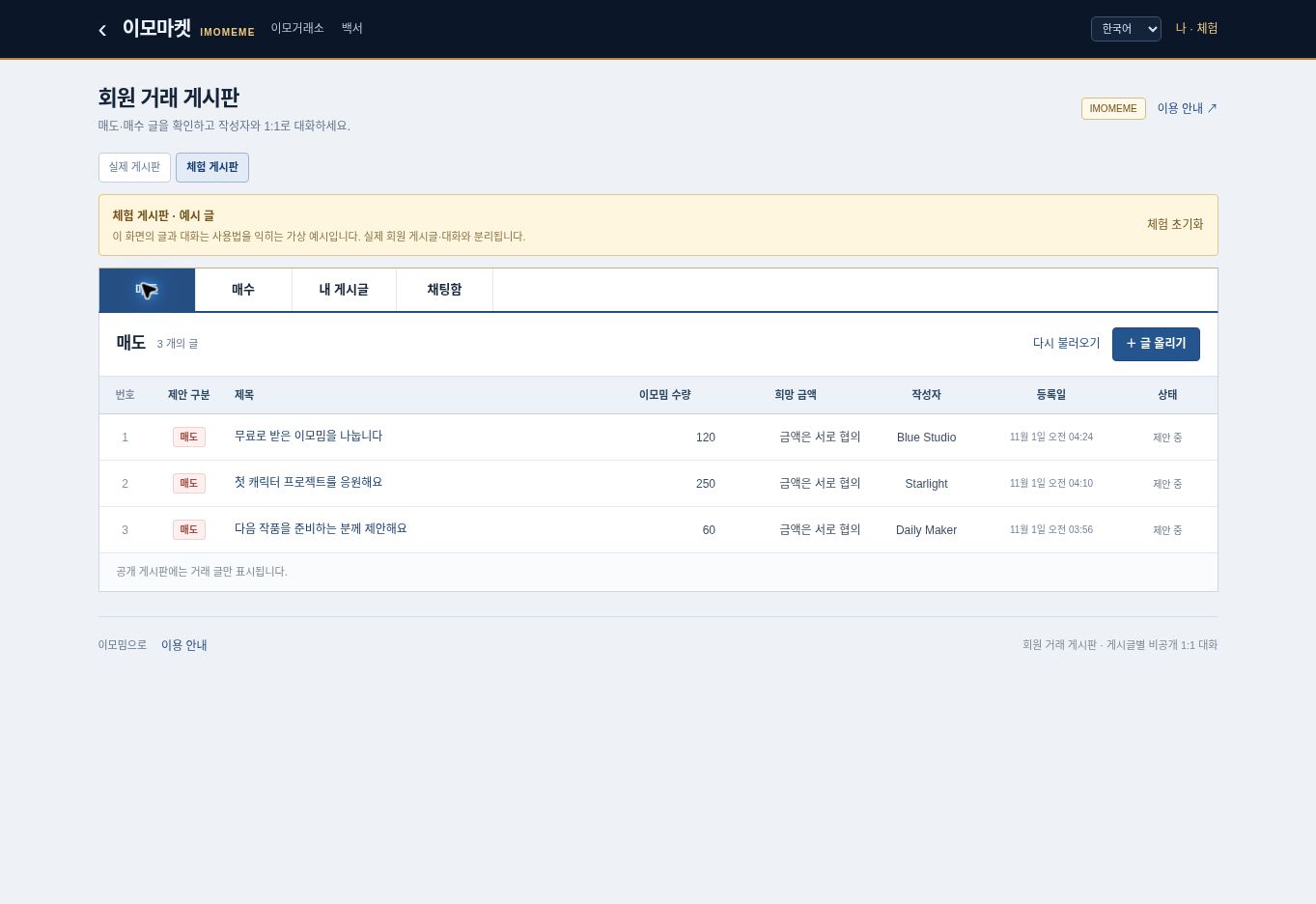
Implemented Korean interface
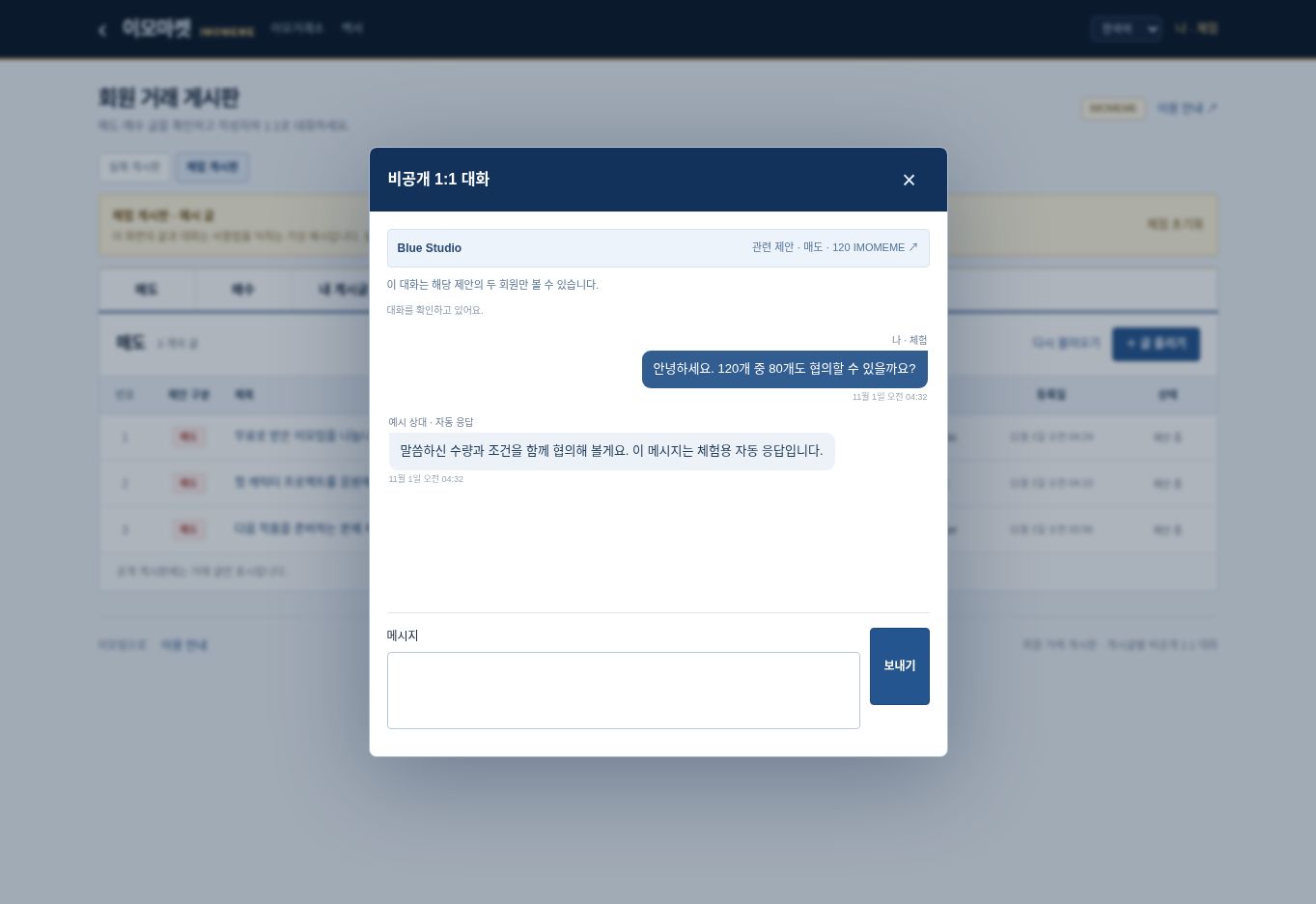
Implemented Korean interface
An IMO Meme Exchange managed directly by its members
IMO Meme Exchange is for participating members with verified creative, production or service-use relationships. It uses the familiar spot-exchange arrangement of coin selection, order book, chart and volume, buy/sell controls and My Orders. Familiar screens carry our participation economy and member-control principles without requiring a separate, complicated procedure.
Layout illustration, not live trading data
Exchange layout diagram: quotes and orders are proposals; charts and filled volume use verified trades
Manage your own orders in IMO Exchange
The coin menu uses the 12 assets in the existing points-payment system’s public active list: USDT, AVAX, BNB, DAI, LINK, PEPE, POL, SHIB, WBTC, WETH, ETH and USDC. Selecting one opens a separate page for that asset and network. Menu availability is distinct from actual exchange support, which requires asset, contract and trading-pair verification. The simulated data below are separate from public orders and actual trading volume.
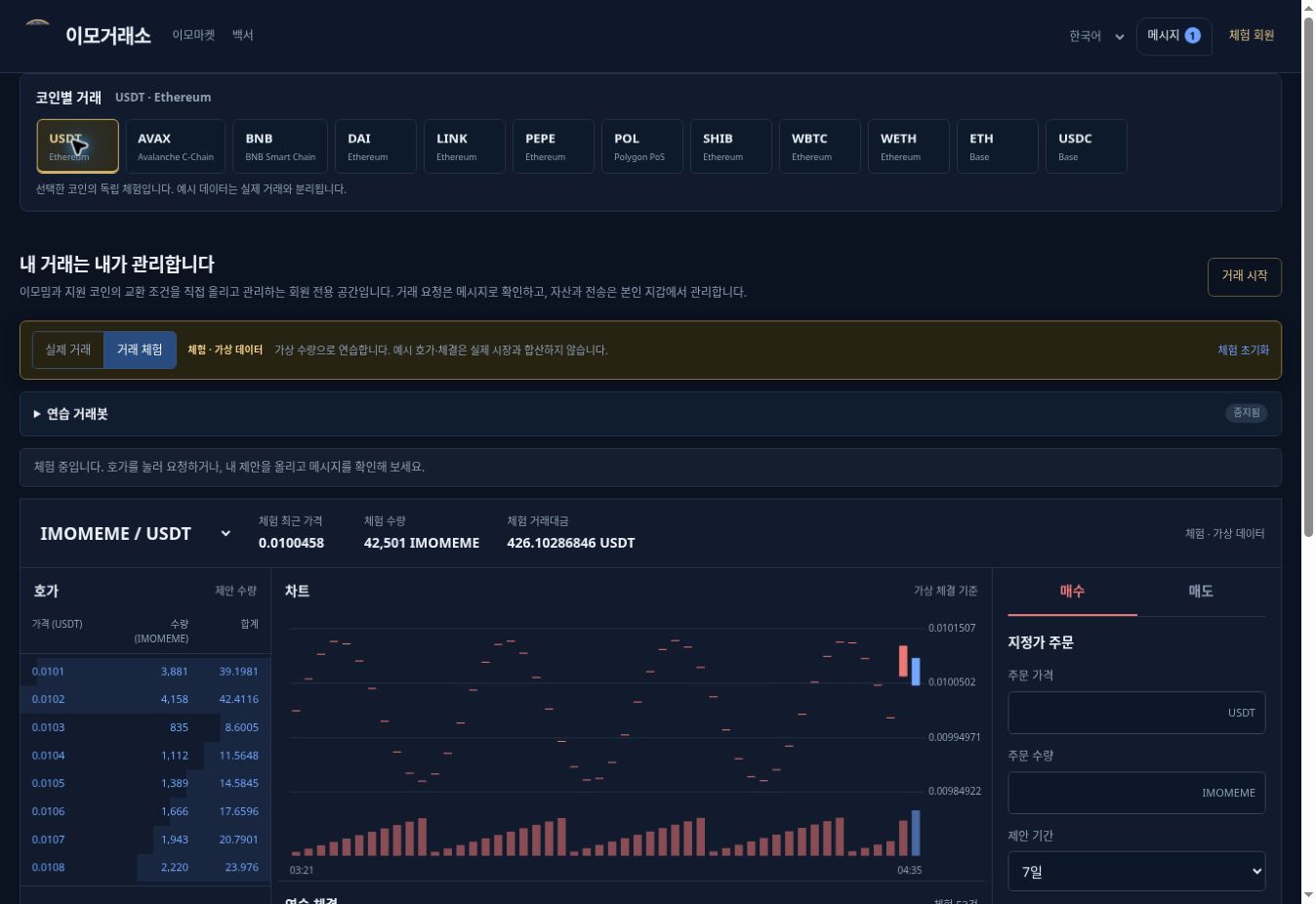
Implemented Korean interface
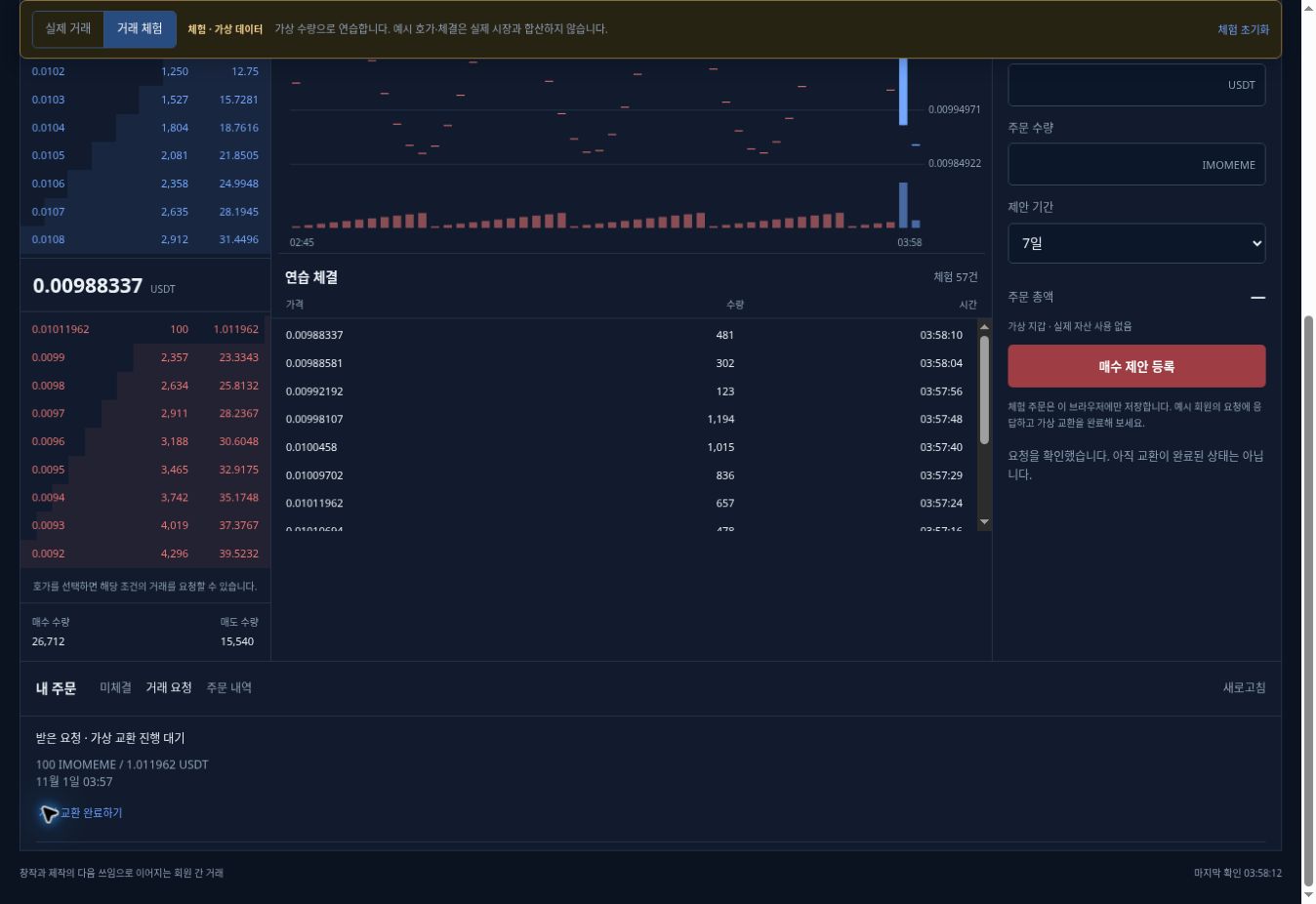
Implemented Korean interface
Choose coins and manage your own orders
Reuse the existing coin-payment asset list for coin selection and display the assets and networks actually available for exchange. This screen does not show point top-up amounts. Members set quantity, price and duration and edit or cancel unfilled remainders. Preserve prior agreements and records of trades already filled. Members manage assets in their own wallets and approve their own transfers.
Receive trade requests in member message bubbles
When another member requests a trade, notify the member who posted the order. Selecting the bubble opens that order and its trade-request details. The posting member reviews the request and decides whether to proceed. Reading a notification or reviewing a request does not mark a trade complete.
Record proposed quantities separately from filled volume
Buy/sell proposals and unfilled remainders are order information. Filled volume includes only trades for which the agreed conditions and actual transfers and receipts of both assets have been verified. Record assets sent and received as one paired trade; do not add quantities of different coins or count the same trade twice. Do not invent chart data or volume for periods without fills.
Manage your own quotes and try the trading flow
In actual mode, “Manage my quotes” starts after wallet verification and explicit consent. It manages one proposal created by that run, using the member’s price range, quantity, spending cap and check interval, and stops when a request arrives. The member decides whether to proceed and approve a wallet transaction. This feature becomes available after supported-asset and contract verification; supported coins are currently being prepared.
In practice mode, members set when to start and stop, the quantity, price and duration. An example request stops the practice bot. The member reviews the request and selects simulated completion to learn the trading flow.
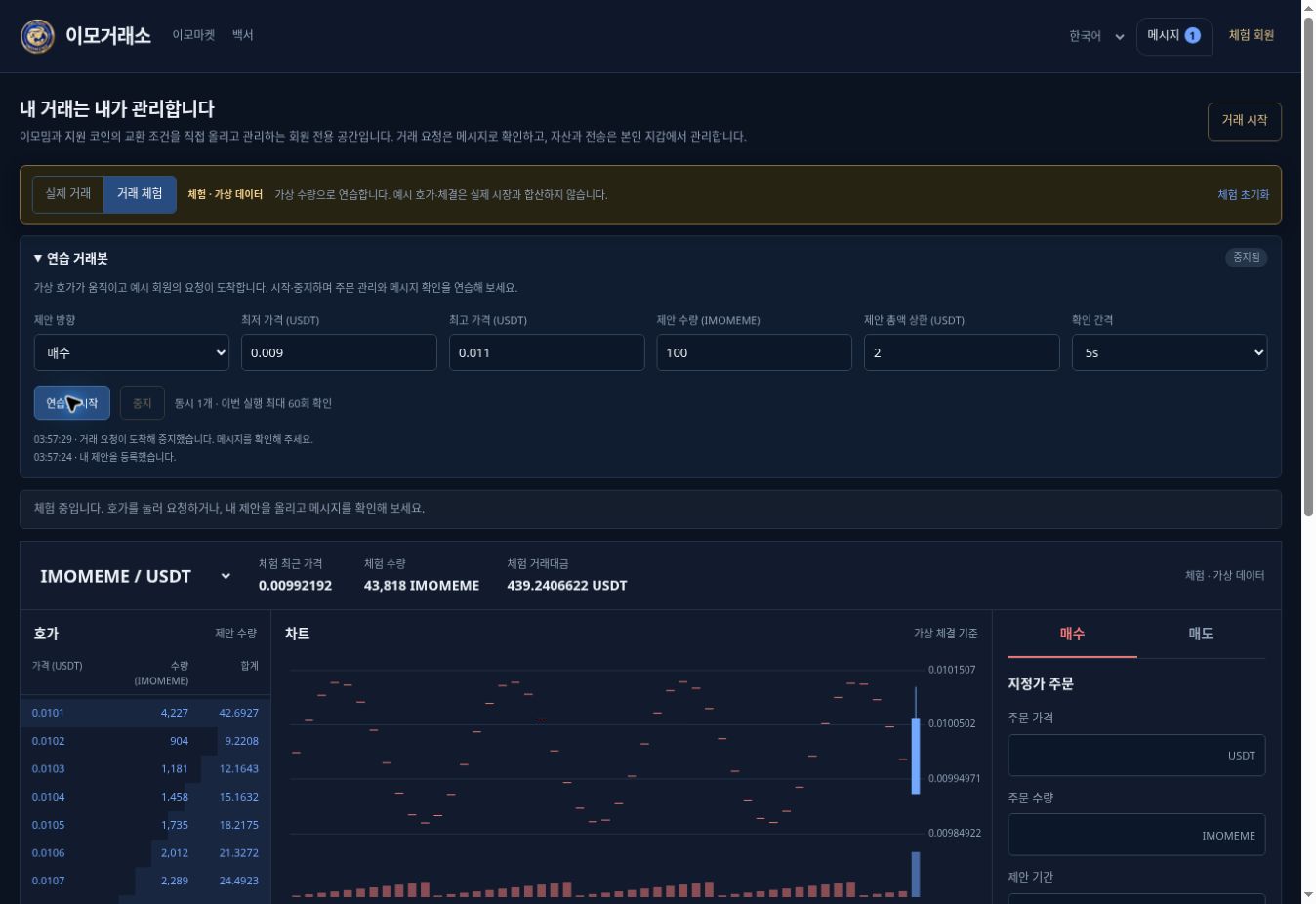
Implemented Korean interface
A DEX is one optional tool for external exchange. Some DEXs also provide self-managed wallets and order cancellation by the maker. Our distinction is connecting familiar trading screens with order control and actual uses for creative and production participants.
The company’s income continues to come from creation, production, commercialisation, content, advertising and business services. The entire value of members’ coin exchanges is not company revenue. The exchange expands the ways participants can choose their next use and manage it directly.
The trading interface, personal order management and request notifications have been implemented. Supported coins are currently being prepared; actual exchange is not provided. Internal rewards, simulated trades and actual external-asset exchange remain separate. Actual exchange is released under the applicable terms and procedures only after issuance, asset, network and transfer verification.
27 The sequence for expanding our assets
- Original artworks and charactersReuse across products
- Creation tools and specificationsConsistent outputs
- Participant relationshipsReasons to return
- Operational collaborationInto physical products and places
A foundation for growth through reuse of existing assets in new applications
| Expansion stage | Value added | Basis for the next stage |
|---|---|---|
| First result | Free characters, product compositing, basic design and viewing | Completion, saving and reuse experiences |
| Repeat production | Images, videos, personal outputs and 3D files | Eligible paid usage, production costs and completion rates |
| Commercialization | Printing, products, rights checks and handoff to producers | Actual production, orders, refunds and contribution margin |
| Business connections | Shops, spaces, rentals, advertising and local inquiries | Confirmed contracts and work that can be settled |
| Broader participation | Rewards under published criteria, partners and an external token | Alignment between round payouts and fulfillment resources |
| New experiences | QR gifts, device experiences and offline use | Connections among rights, devices, merchants and settlement |
We publish schedules based on results to complete rather than arbitrary launch dates. Instead of announcing all prepared businesses as achieved performance, we progressively expand the results users can actually receive. Reusable original works and tools mean each expansion need not start from scratch.
Rights and records we protect
We verify available rights and the scope of commercial use for works, retaining author approval and lineage. Children's materials follow guardian choices, and personal memories follow the individual's choices. Transactions, refunds, production cancellations and payout errors can be checked in the relevant records. Receiving a token does not require a blanket transfer of artwork rights or personal information.
The order in which we disclose metrics
We connect and disclose valid participation, completion, saving and repeat use; paid usage and actual costs; orders, refunds and creator settlements; advertising inquiries and contract revenue; and finally allocation, circulation and burning. Registrations and token transfer volume alone do not determine business success.
With the creative and everyday-life tools we have prepared over 5 months, we are expanding a market where people create for the first time, reuse what they make and develop it into their own businesses. Reusing original works and tools, repeat production and business customers' repeat orders are the paths to realizing our revenue outlook. Users' works and materials, acquired knowledge and preserved memories create new uses for IMO Meme. Revenue from the businesses providing that utility broadens the next opportunities to participate and create.
Appendix 1 Business scope and delivery stages
The menus, registration guidance, detailed descriptions and linked projects on the IMO Meme page are preserved within the scope below. Verifying screens, policies and files is distinguished from completed paid production and sales.
| Businesses and functions preserved | Whitepaper location | Scope verified |
|---|---|---|
| Images, videos, social media, ads, websites, portfolios, group and travel content | Chapter 4 | Current Creative Studio entry categories |
| 4 official characters, free product compositing, PNG and transparent designs | Chapter 5 | Editing and saving tools |
| Viewing, comparisons, remix lineage, public review and glossary | Chapters 5, 10 and 13 | Entry into participation and creation |
| Paid 2.5D, free base symbol models and 3D production files | Chapter 6 | Tools, quotations and file packages |
| Clothing, measured spaces, household products and invention drawings | Chapter 7 | Basic models and linked dimensions |
| Children's workshop, travel products, accessibility and producers | Chapter 8 | Published business offerings |
| Artwork recommendations, shops, spaces, rentals, QR and corporate gifts | Chapter 9 | Visualization and business design |
| Webtoons, creator registration, contracts, settlement and rights | Chapter 10 | Portal and published operating rules |
| Wolha, Astra, Seonjae, Doyun, talismans and future appearances | Chapter 10 | Personal stories and production paths |
| My Digital Self, personal records, youthful-living care and Donguibogam | Chapter 11 | Programs and expansion offerings |
| Korea and U.S. travel, Together, My Travel, ads and business inquiries | Chapter 12 | Services, free experiences and expansion concepts |
| Creative MARKET, IMO Partners and IMO Market | Chapter 13 | Sales preparation, introductions and proposals |
| QR gifts, AR, VR, XR, holograms and restaurants | Chapter 14 | Expansion preparation and demonstrations |
| Points, mixed payments, Refund Center and My Works | Chapters 13, 16 and 21 | Operating foundations |
| Fixed supply, round claims, member wallets and IMO Meme Exchange | Chapters 22–26 | Design and development of issuance and optional exchange |
Appendix 2 Sources and matters to finalize for publication
Published services and policies
IMO Meme page https://savorip.com/ko/airdrop — Main content, registration guidance, creating, more, participation and service connections
Creative Studio https://savorip.com/ko/studio — Current production categories and published products and workshops
3D https://savorip.com/ko/3d-products — Production types, quotations and output formats
Operating policy https://savorip.com/api/imo-payment-v2/policy — Internal conversion, eligible rewards, limits and chain-issuance status
Prices and top-ups /api/membership/policy · /api/point-packages?lang=ko · /api/payment-channels?lang=ko
Programs /ko/my-fate · /ko/donguibogam · /ko/webtoon — Stories, culture and creator policies
Personal programs /static/cyborg-learning-v2/index.html · /static/cyborg-care-v4/index.html
Markets /en/creative-start · /en/partners · /en/imomarket · IMO Meme Exchange development — sales preparation, introduction tools, member trade proposals and optional exchange
IMO Travel https://imohelper.com/ — Everyday life, travel and local advertising connections
Travel expansion https://imohelper.com/us/?lang=ko · https://imohelper.com/together?locale=ko · /together/pass?locale=ko
Advertising operations https://imohelper.com/partner/ads · https://imohelper.com/for-business?locale=ko
Technical source https://docs.base.org/specifications/reference/smart-contracts — Base support for ERC20 contracts
Principle for assessing rights https://www.fsc.go.kr/no010101/79386 — The Financial Services Commission's substance-based assessment principle in its token-securities framework
Business and issuance materials provided
We compared the IMO Issuance Plan, IMO Distribution Whitepaper, IMO Distribution Participation Guide, IMO Meme Coin Issuance and Use Whitepaper V1 and V2, terms of use, business, asset and address management materials, the endpoint register, the pre-deployment audit report and the Saebori Response Engine Guidelines. Where historical planning figures differ from current published policy, their applicable scopes are separated in the text.
Use of existing images
The photographs and example outputs in the text use existing service assets, with explanatory diagrams added for roles, figures and calculations. U.S. travel, Together and advertising scenes are existing illustrative images and are distinguished from evidence of actual customers, contracts or revenue. Brain materials retain the BodyParts3D / DBCLS CC BY 4.0 attribution.
Four matters to finalize for external publication
First, the legal name and contact details of the issuing and operating entity. Second, the final allocation and unlocking rules for external issuance, contract addresses and deployment evidence. Third, eligible conversion balances, limits and fulfillment resources between internal iMo and the external token. Fourth, actual revenue, costs and contract performance, and round budgets that can be disclosed. These items will be included in official disclosures rather than filled with invented figures.
Reference date: October 31, 2026. Exit chapter revised November 1, 2026. Public pages and policies may change; check the version and final quote actually applicable when using services or trading.